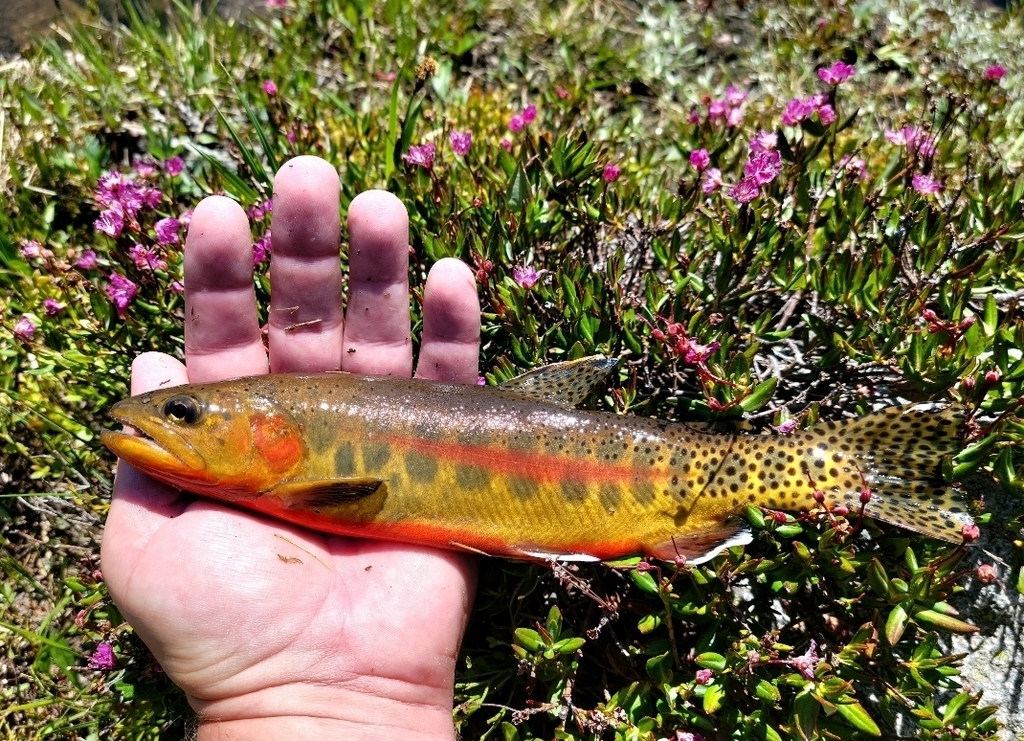
The Rainbow trout (Oncorhynchus mykiss) is a fish that lives in both fresh and salt water of the family Salmonidae that grows up to 122 cm.
Description
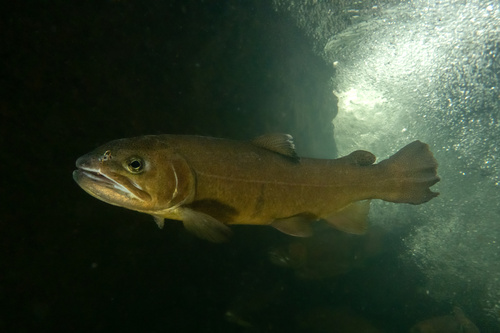
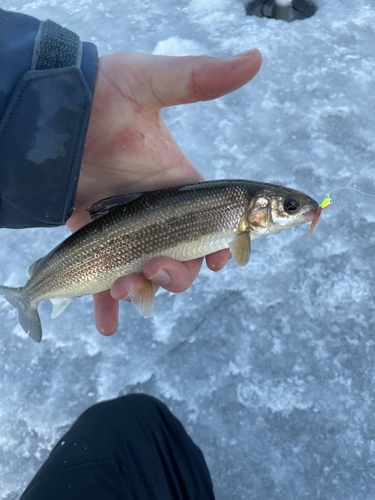
The rainbow trout is a streamlined salmonid of the family Salmonidae that can reach about 120 cm but usually stays much smaller. It is characterised by the adipose fin between dorsal and tail fin and a broad pink to rainbow-coloured band along the silvery, dark-speckled flank. The species is native to the cool waters of western North America but has been introduced worldwide for sport fishing and aquaculture and now also occurs in many European rivers and lakes. It hunts insects, crustaceans and small fish and spawns in cool, flowing water. Some populations migrate to sea as 'steelhead'. Because of its tasty flesh it is a highly valued food and sport fish.
Frequently asked questions
How do you recognise the Rainbow trout?
The Rainbow trout has a torpedo-shaped body, is mainly silver-grey and shows a spots pattern.
Where does the Rainbow trout live?
The Rainbow trout lives in both fresh and salt water and is mostly found around mixed bottom.
How big does the Rainbow trout get?
The Rainbow trout grows to a maximum of about 122 cm. On average the species is around 60 cm.
Is the Rainbow trout dangerous to humans?
No, the Rainbow trout is harmless to humans.
Is the Rainbow trout edible?
Yes, the Rainbow trout is a highly prized food fish.
Download Fin's Fish Guide
Identify fish in seconds, log your catches and dives. Join the TestFlight beta.
All data
Identification
Appearance
Habitat & distribution
Behaviour & biology
For anglers
Safety
Status & sources
Same genus Oncorhynchus
More from the family Salmonidae

Download Fin's Fish Guide
Identify fish in seconds, log your catches and dives. Join the TestFlight beta.