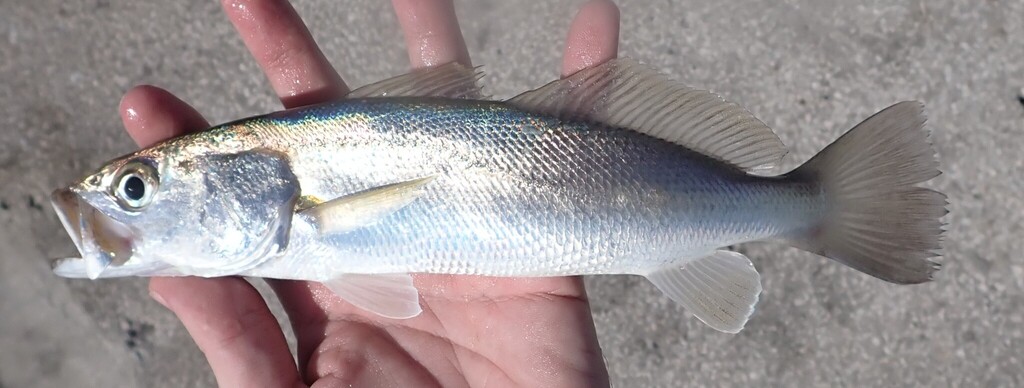
The Sand seatrout (Cynoscion arenarius) is a fish that lives in both fresh and salt water of the family Sciaenidae that grows up to 64 cm.
Description
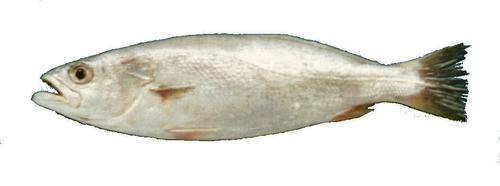
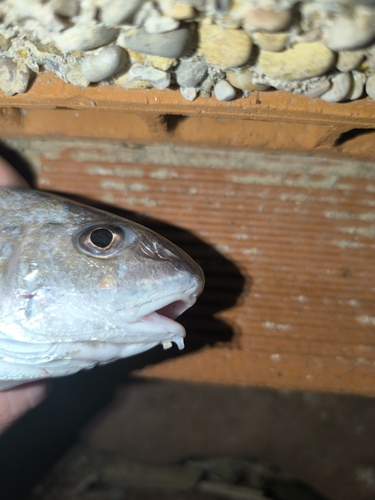
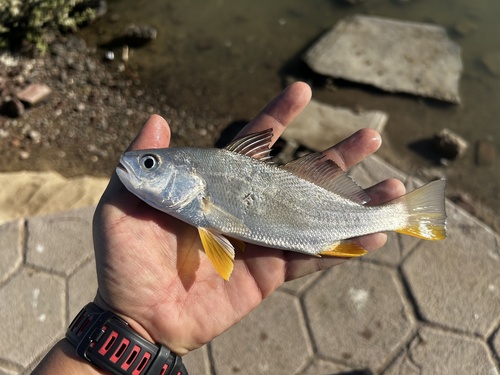
The sand seatrout is a slender, silvery drum of the family Sciaenidae reaching about 64 cm. The streamlined body is silvery with a yellowish cast; the upper jaw holds a pair of large, pointed canine teeth. Like many drums it makes drumming sounds with muscles around the swim bladder. The species lives in schools on sand and mud bottoms of shallow coastal water and estuaries of the Gulf of Mexico and tolerates brackish water. On the bottom it hunts shrimp, small fish and other crustaceans. Because of its tasty flesh and good fight it is a prized sport and market fish along the Gulf coast and an important coastal species.
Frequently asked questions
How do you recognise the Sand seatrout?
The Sand seatrout has a torpedo-shaped body, is mainly silver-grey and shows a plain pattern.
Where does the Sand seatrout live?
The Sand seatrout lives in both fresh and salt water and is mostly found around sand or mud bottom.
How big does the Sand seatrout get?
The Sand seatrout grows to a maximum of about 64 cm. On average the species is around 35 cm.
Is the Sand seatrout dangerous to humans?
No, the Sand seatrout is harmless to humans.
Is the Sand seatrout edible?
Yes, the Sand seatrout is commonly eaten.
Download Fin's Fish Guide
Identify fish in seconds, log your catches and dives. Join the TestFlight beta.
All data
Identification
Appearance
Habitat & distribution
Behaviour & biology
For anglers
Safety
Status & sources
Same genus Cynoscion

More from the family Sciaenidae

Download Fin's Fish Guide
Identify fish in seconds, log your catches and dives. Join the TestFlight beta.