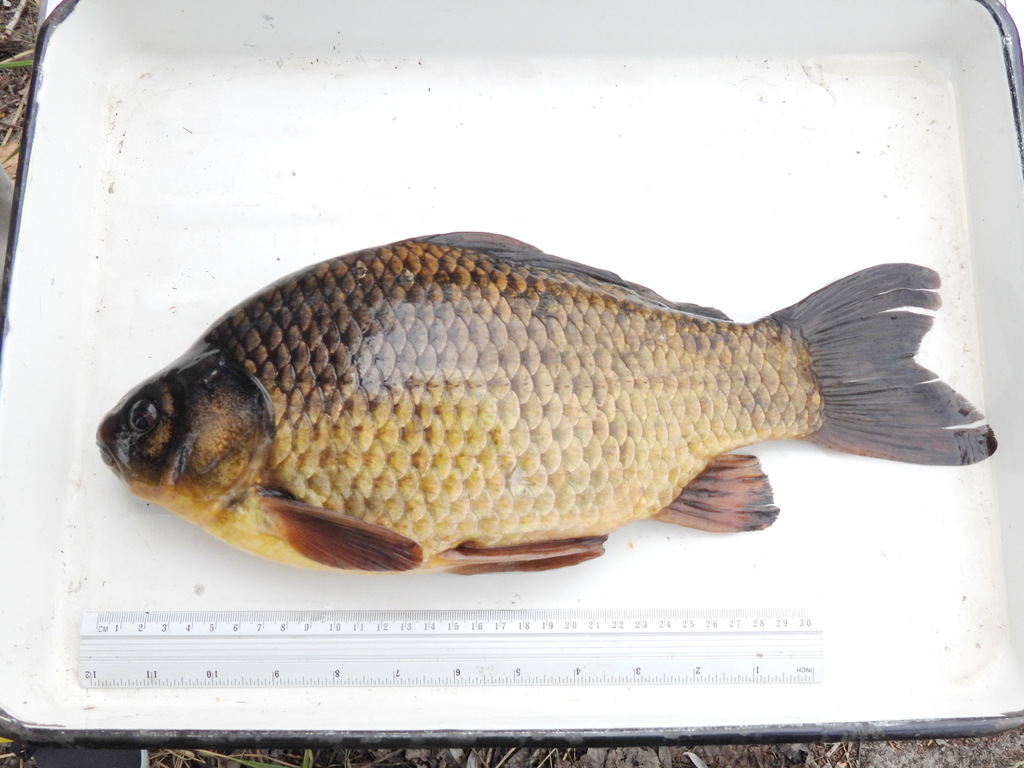
The Gibel carp (Carassius gibelio) is a freshwater fish of the family Cyprinidae that grows up to 47 cm.
Description
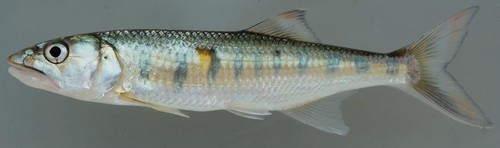
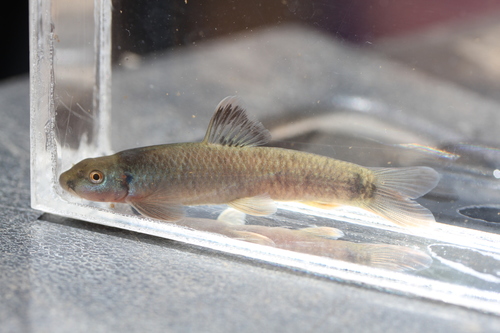
The gibel carp or Prussian carp is a hardy cyprinid of the family Cyprinidae reaching about 45 cm. It resembles the crucian carp but is greyer and more slender, with a straight to slightly concave dorsal fin and no barbels; it is the wild ancestor of the goldfish. The gibel carp tolerates oxygen-poor, warm and polluted water very well. Native to eastern Europe and Asia, it has become strongly invasive across western Europe, including the Netherlands. Notorious is its reproduction: many populations consist almost entirely of females that reproduce clonally through gynogenesis, using sperm of other cyprinids only as a trigger. Through its hardiness and rapid increase it displaces native fish.
Frequently asked questions
How do you recognise the Gibel carp?
The Gibel carp has a torpedo-shaped body, is mainly silver-grey and shows a plain pattern.
Where does the Gibel carp live?
The Gibel carp lives in fresh water and is mostly found around mixed bottom.
How big does the Gibel carp get?
The Gibel carp grows to a maximum of about 47 cm. On average the species is around 20 cm.
Is the Gibel carp dangerous to humans?
No, the Gibel carp is harmless to humans.
Is the Gibel carp edible?
The Gibel carp is rarely eaten.
Download Fin's Fish Guide
Identify fish in seconds, log your catches and dives. Join the TestFlight beta.
All data
Identification
Appearance
Habitat & distribution
Behaviour & biology
For anglers
Safety
Status & sources
Same genus Carassius

More from the family Cyprinidae


Download Fin's Fish Guide
Identify fish in seconds, log your catches and dives. Join the TestFlight beta.