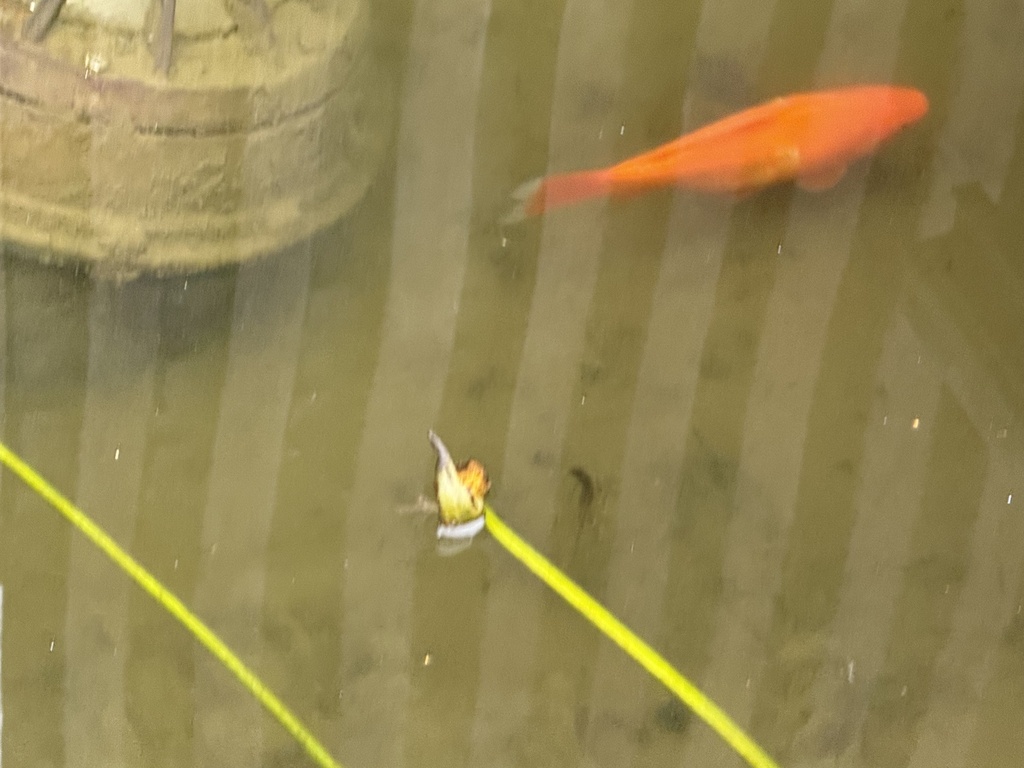
The Goldfish (Carassius auratus) is a brackish-water fish of the family Cyprinidae that grows up to 48 cm.
Description
The goldfish is a member of the carp family (Cyprinidae) that reaches almost 50 cm in the wild but usually stays smaller in aquaria. Unlike the related common carp it lacks barbels. The wild form is olive-brown, while cultivated varieties can be orange, red, white or black. The dorsal fin carries a few spines and the tail is forked. Native to East Asia, the goldfish has been spread worldwide through the aquarium and pond trade and is locally invasive. It is an omnivore eating plankton, benthic animals, plants and detritus. Goldfish spawn in spring and summer, laying sticky eggs on submerged vegetation.
Frequently asked questions
How do you recognise the Goldfish?
The Goldfish has a torpedo-shaped body, is mainly red-orange and shows a plain pattern.
Where does the Goldfish live?
The Goldfish lives in brackish water and is mostly found around mixed bottom.
How big does the Goldfish get?
The Goldfish grows to a maximum of about 48 cm. On average the species is around 10 cm.
Is the Goldfish dangerous to humans?
No, the Goldfish is harmless to humans.
Is the Goldfish edible?
The Goldfish is rarely eaten.
Download Fin's Fish Guide
Identify fish in seconds, log your catches and dives. Join the TestFlight beta.
All data
Identification
Appearance
Habitat & distribution
Behaviour & biology
For anglers
Safety
Status & sources
Same genus Carassius
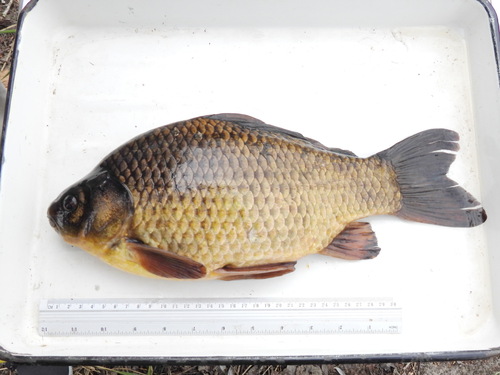
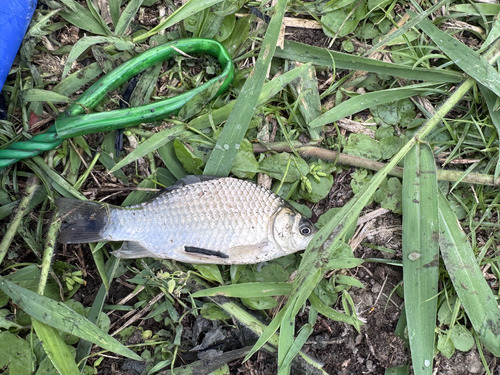

More from the family Cyprinidae


Download Fin's Fish Guide
Identify fish in seconds, log your catches and dives. Join the TestFlight beta.