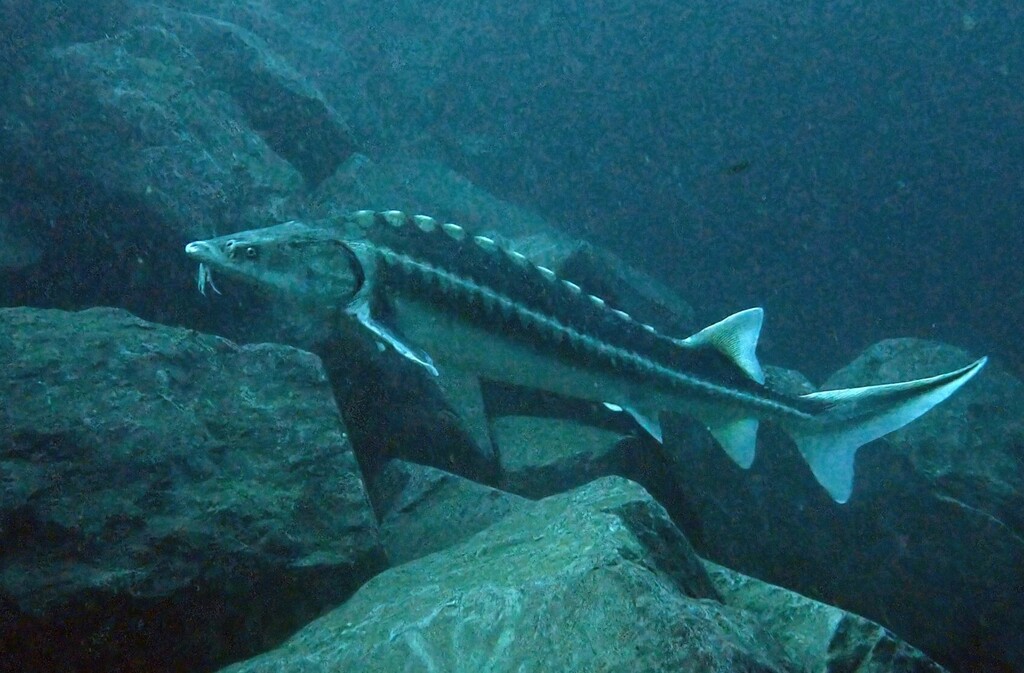
The Russian sturgeon (Acipenser gueldenstaedtii) is a fish that lives in both fresh and salt water of the family Acipenseridae that grows up to 236 cm.
Description
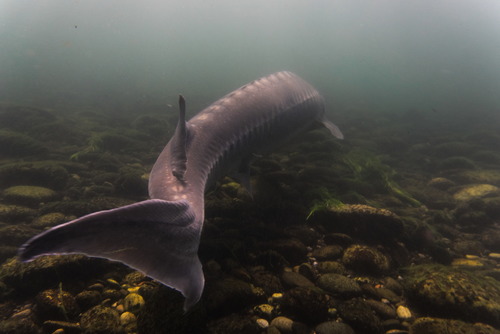
The Russian sturgeon is a large sturgeon of the family Acipenseridae reaching about 2.3 metres, sometimes more. It has a short, blunt and somewhat upturned snout; beneath the snout hang smooth barbels with which it probes the bottom. Like all sturgeons it bears five lengthwise rows of bony plates instead of ordinary scales. It is an anadromous migrant of the Black, Azov and Caspian Sea basins, growing up at sea and ascending great rivers such as the Danube and Volga to spawn. On the bottom it eats molluscs, worms, crustaceans and small fish. Its roe yields the famous osetra caviar, for which it has been heavily overfished; together with river barriers this has made the species Critically Endangered (CR).
Frequently asked questions
How do you recognise the Russian sturgeon?
The Russian sturgeon has a torpedo-shaped body, is mainly brown and shows a plain pattern.
Where does the Russian sturgeon live?
The Russian sturgeon lives in both fresh and salt water and is mostly found around sand or mud bottom.
How big does the Russian sturgeon get?
The Russian sturgeon grows to a maximum of about 236 cm. On average the species is around 145 cm.
Is the Russian sturgeon dangerous to humans?
No, the Russian sturgeon is harmless to humans.
Is the Russian sturgeon edible?
Yes, the Russian sturgeon is a highly prized food fish.
Download Fin's Fish Guide
Identify fish in seconds, log your catches and dives. Join the TestFlight beta.
All data
Identification
Appearance
Habitat & distribution
Behaviour & biology
For anglers
Safety
Status & sources
Same genus Acipenser



More from the family Acipenseridae
Download Fin's Fish Guide
Identify fish in seconds, log your catches and dives. Join the TestFlight beta.