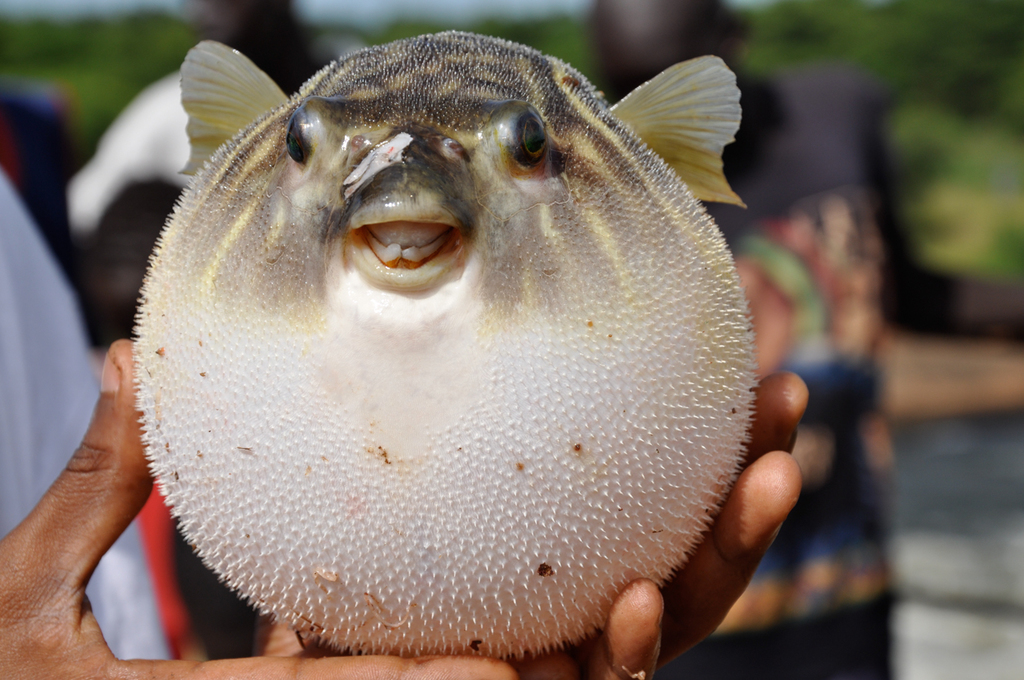
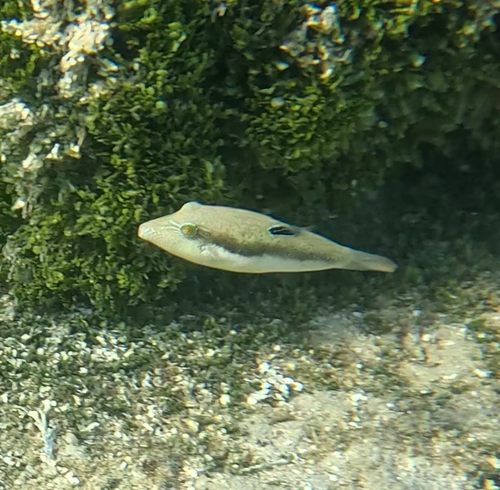
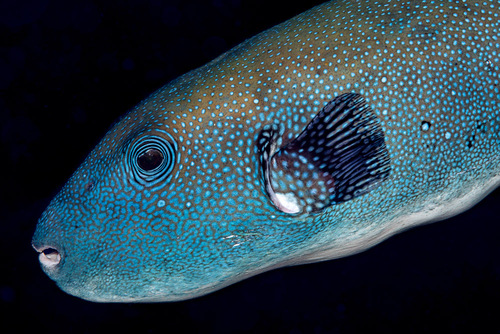
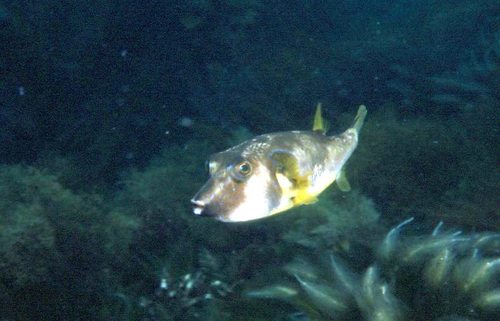
The Coral butterfly (Tetraodon lineatus) is a brackish-water fish of the family Tetraodontidae that grows up to 43 cm.
Description
The Nile puffer, also called the fahaka, is a large freshwater pufferfish (family Tetraodontidae) widespread in Africa. The species grows to about 43 cm and has a stocky body with yellow-brown longitudinal stripes and, instead of separate teeth, a beak of fused teeth. It lives in large rivers and lakes, in open water and vegetated margins, and feeds mainly on molluscs such as snails and mussels, which it crushes with its powerful beak. Like other pufferfish it can inflate itself and the body contains tetrodotoxin, making it poisonous to eat.
Frequently asked questions
How do you recognise the Coral butterfly?
The Coral butterfly has a flattened, disc-shaped body, is mainly yellow-gold and shows a horizontal stripes pattern.
Where does the Coral butterfly live?
The Coral butterfly lives in brackish water and is mostly found around sand or mud bottom.
How big does the Coral butterfly get?
The Coral butterfly grows to a maximum of about 43 cm.
Is the Coral butterfly dangerous to humans?
No, the Coral butterfly is harmless to humans.
Is the Coral butterfly edible?
The Coral butterfly is not usually eaten.
Download Fin's Fish Guide
Identify fish in seconds, log your catches and dives. Join the TestFlight beta.
All data
Identification
Appearance
Habitat & distribution
Behaviour & biology
For anglers
Safety
Status & sources
Same genus Tetraodon

More from the family Tetraodontidae

Download Fin's Fish Guide
Identify fish in seconds, log your catches and dives. Join the TestFlight beta.