Home · Scorpaenidae · Red lionfish
Red lionfish (Pterois volitans) — Scorpaenidae

Red lionfish

Pterois volitans
Family: Scorpaenidae
LC · Least Concern
NativeIntroduced

The Red lionfish (Pterois volitans) is a saltwater fish of the family Scorpaenidae that grows up to 46 cm.

Length
45.7 cm
Water
Saltwater
Depth
2–55 m
Diet
Carnivore
Behaviour
Solitary
Activity
Nocturnal
Body shape
Torpedo-shaped
Substrate
Stone or rock
Danger
Venomous
Range
Indo-Pacific, on lagoon and seaward reefs from turbid coastal areas to about 50 m depth.
Edibility
Commonly eaten

Want the complete picture on the Red lionfish?

Description

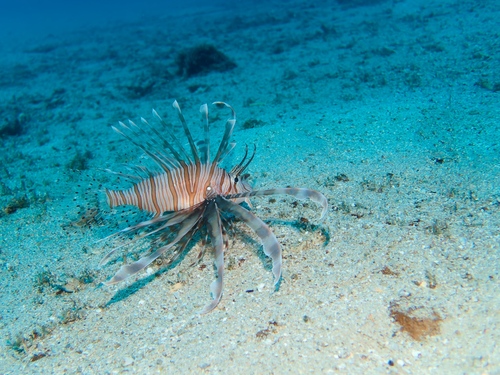
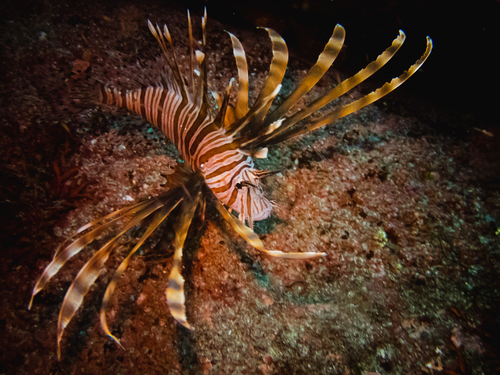
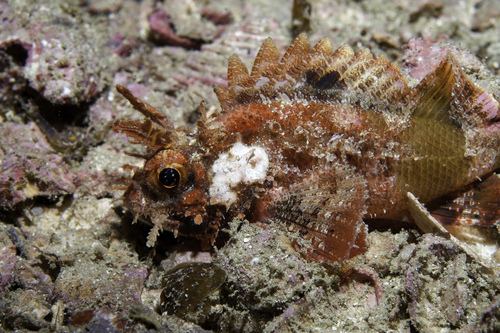
The red lionfish is a striking scorpionfish (family Scorpaenidae) originally from the Indo-Pacific. The species grows to about 46 cm and has a red-and-white striped body with long, fan-like pectoral fins and a row of venomous spines on the back. It inhabits lagoon and seaward reefs, from turbid inshore areas to about 50 m depth, and is often solitary; by day it hangs almost motionless head-down in sheltered places, and at night it hunts small fishes and crustaceans. The spines can deliver a very painful, venomous sting. Outside its native range the species is notorious as an invasive intruder in the Atlantic.

Frequently asked questions

How do you recognise the Red lionfish?

The Red lionfish has a torpedo-shaped body, is mainly red-orange and shows a vertical stripes pattern. Long, fan-shaped fins with venomous spines; notorious as an invasive species in the Atlantic Ocean.

Where does the Red lionfish live?

The Red lionfish lives in the sea (marine waters) and is mostly found around stony or rocky ground. Indo-Pacific, on lagoon and seaward reefs from turbid coastal areas to about 50 m depth.

How big does the Red lionfish get?

The Red lionfish grows to a maximum of about 46 cm.

Is the Red lionfish dangerous to humans?

The Red lionfish is venomous — handle spines with care and seek medical help after a sting if needed. For a sting from the venomous spines: immerse the affected area in hot water (about 45 C) for 30-90 minutes to ease pain, remove any spine fragments, clean the wound, and seek medical care if symptoms are severe.

Is the Red lionfish edible?

Yes, the Red lionfish is commonly eaten.

More photos

Red lionfish (Pterois volitans) — Scorpaenidae — 2
Wikimedia Commons — Jens Petersen (Edit by Olegiwit) (CC BY 2.5)
Red lionfish (Pterois volitans) — Scorpaenidae — 3
Jay Paroline (CC BY 4.0) via GBIF — iNaturalist
Red lionfish (Pterois volitans) — Scorpaenidae — 4
iNaturalist ((c) jordan-kotsuki, some rights reserved (CC BY-NC))
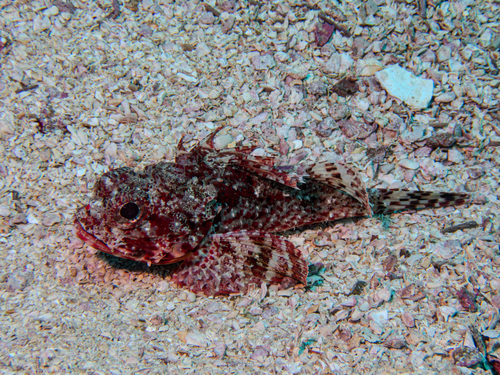
Red lionfish (Pterois volitans) — Scorpaenidae — 5
Wikimedia Commons — No machine-readable author provided. RicciSpeziari~commonswiki assumed (based on copyright claims). (CC BY-SA 3.0)

Want the complete picture on the Red lionfish?

Point your camera at the fish and Fin names the species in seconds. Free, and the Red lionfish is one of 12,519 species in the app.

All data

Identification

English name
Red lionfish verified
Scientific name
Pterois volitans
Family
Scorpaenidae
Other names
Butterfly cod; Common lionfish; Featherfins; Fire fish; Red lionfish; Lionfish; Turkeyfish; Lion fish; Red firefish; Ornate butterfly-cod; Peacock lionfish; Scorpion volitans verified

Appearance

Size class
Large verified
Max length (cm)
45.7 verified
Body shape
Torpedo-shaped sourced
Dominant colour
Red / orange
Pattern
Vertical bars
Tail shape
Rounded
Mouth position
Terminal
Lips
Thick / fleshy
Barbels
No sourced
Dorsal fins
One continuous
Dorsal spines
Yes sourced

Habitat & distribution

Water type
Saltwater sourced
Substrate
Stone or rock sourced
Min depth (m)
2 verified
Max depth (m)
55 verified
Natural range
Indo-Pacific, on lagoon and seaward reefs from turbid coastal areas to about 50 m depth.
Origin
Native sourced

Behaviour & biology

Diet
Carnivore sourced
Diet (detail)
Small fishes and crustaceans sourced
Social behaviour
Solitary
Territorial
No
Activity
Nocturnal
Reproduction
Separate sexes sourced
Sexual dimorphism
No
Max. age (years)
10 verified
Seasonality
Present year-round in its habitat; no pronounced seasonality known.
Special features
Long, fan-shaped fins with venomous spines; notorious as an invasive species in the Atlantic Ocean. sourced

For anglers

Edibility
Commonly eaten sourced
Fishing method
Caught mainly with a spear or a hand net; watch out for the venomous spines. Actively fished in the Caribbean to curb the invasion. sourced
Regulations source

Safety

Danger to humans
Venomous sourced
First aid
For a sting from the venomous spines: immerse the affected area in hot water (about 45 C) for 30-90 minutes to ease pain, remove any spine fragments, clean the wound, and seek medical care if symptoms are severe. sourced

Status & sources

Sources
FishBase via GBIF (DwC-A), CC-BY-NC 4.0

Same genus Pterois

More from the family Scorpaenidae

Want the complete picture on the Red lionfish?

Point your camera at the fish and Fin names the species in seconds. Free, and the Red lionfish is one of 12,519 species in the app.

Is this the Red lionfish?