 Fin's Fish Guide

The Pronothobranchius kiyawensis is a freshwater fish of the family Nothobranchiidae that grows up to 4 cm.
Lake Chad basin in West and Central Africa, in temporary pools and swamps.
Description
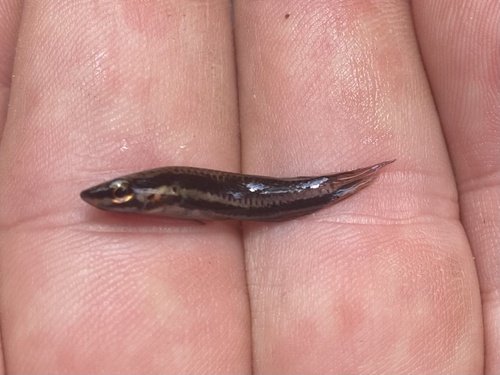
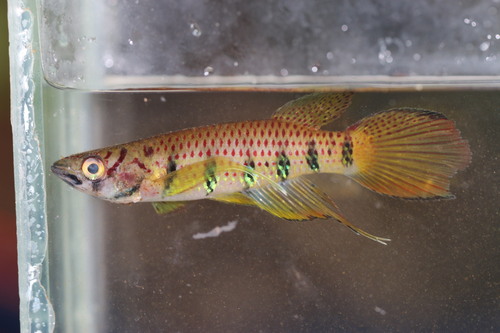
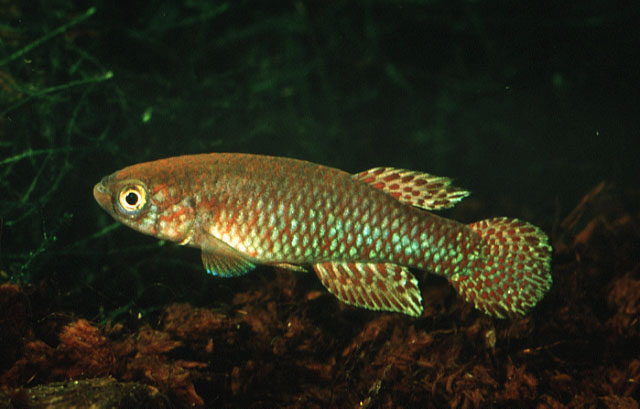
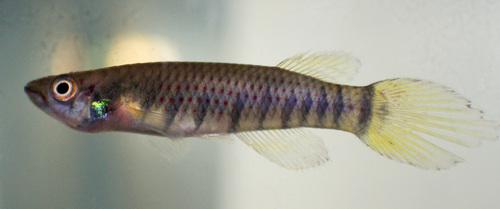
The West African seasonal killi is a small, short-lived killifish of the family Nothobranchiidae from the savannas of the Lake Chad basin in West and Central Africa. The species reaches only about 4 cm; the males are brightly coloured with blue and red tones. It lives in temporary pools and swamps that dry out completely in the dry season. It is a true annual fish: the bottom-laid eggs survive the dry period in the mud and hatch after about a month and a half once the rains return. Owing to this dependence on vulnerable temporary waters the species is assessed by the IUCN as endangered (EN).
Frequently asked questions
How do you recognise the Pronothobranchius kiyawensis?
The Pronothobranchius kiyawensis has an elongate, eel-like body, is mainly blue and shows a vertical stripes pattern. Annual seasonal fish whose eggs survive the dry season in the mud; IUCN status endangered.
Where does the Pronothobranchius kiyawensis live?
The Pronothobranchius kiyawensis lives in fresh water and is mostly found around mixed bottom. Lake Chad basin in West and Central Africa, in temporary pools and swamps.
How big does the Pronothobranchius kiyawensis get?
The Pronothobranchius kiyawensis grows to a maximum of about 4 cm. On average the species is around 4 cm.
Is the Pronothobranchius kiyawensis dangerous to humans?
No, the Pronothobranchius kiyawensis is harmless to humans. None required: this species is harmless to humans.
Is the Pronothobranchius kiyawensis edible?
The Pronothobranchius kiyawensis is not usually eaten.

Want the complete picture on the Pronothobranchius kiyawensis?
Point your camera at the fish and Fin names the species in seconds. Free, and the Pronothobranchius kiyawensis is one of 12,519 species in the app.
All data
Identification
Appearance
Habitat & distribution
Behaviour & biology
For anglers
Safety
Status & sources
More from the family Nothobranchiidae



Want the complete picture on the Pronothobranchius kiyawensis?
Point your camera at the fish and Fin names the species in seconds. Free, and the Pronothobranchius kiyawensis is one of 12,519 species in the app.