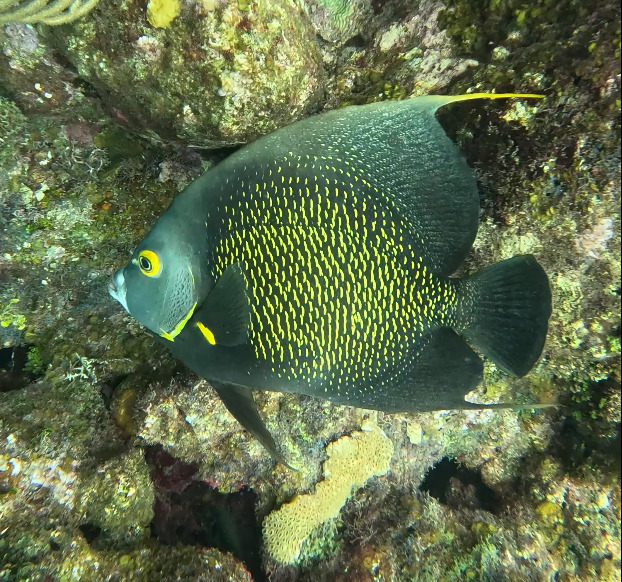
The Angelfish (Pomacanthus paru) is a saltwater fish of the family Pomacanthidae that grows up to 41 cm.
Description
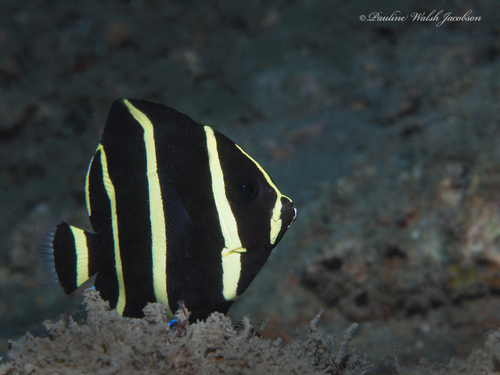
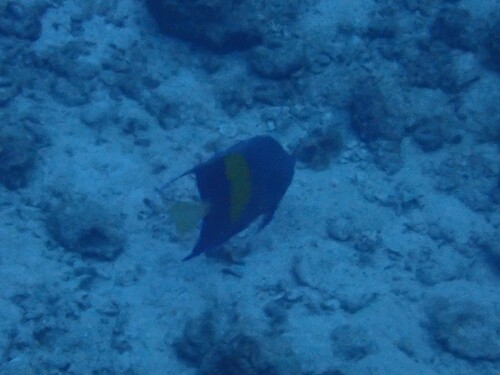
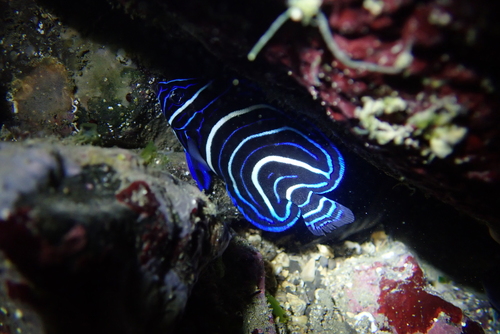
The French angelfish is an angelfish of the family Pomacanthidae from the western Atlantic and Caribbean. The species grows to about 40 cm and has a deep, disc-shaped, black body whose scales are edged with yellow, giving an ornate speckled effect; juveniles are black with bright yellow bars. It is common on shallow reefs, usually in pairs and often near sea fans. As an omnivore it feeds mainly on sponges, plus algae, bryozoans, coral polyps and tunicates. Juvenile French angelfish act as cleaners for other fishes. The species is harmless to humans.
Frequently asked questions
How do you recognise the Angelfish?
The Angelfish has a flattened, disc-shaped body, is mainly black and shows a spots pattern.
Where does the Angelfish live?
The Angelfish lives in the sea (marine waters) and is mostly found around stony or rocky ground.
How big does the Angelfish get?
The Angelfish grows to a maximum of about 41 cm. On average the species is around 28 cm.
Is the Angelfish dangerous to humans?
The Angelfish is venomous — handle spines with care and seek medical help after a sting if needed.
Is the Angelfish edible?
The Angelfish is rarely eaten.
Download Fin's Fish Guide
Identify fish in seconds, log your catches and dives. Join the TestFlight beta.
All data
Identification
Appearance
Habitat & distribution
Behaviour & biology
For anglers
Safety
Status & sources
Same genus Pomacanthus
More from the family Pomacanthidae
Download Fin's Fish Guide
Identify fish in seconds, log your catches and dives. Join the TestFlight beta.