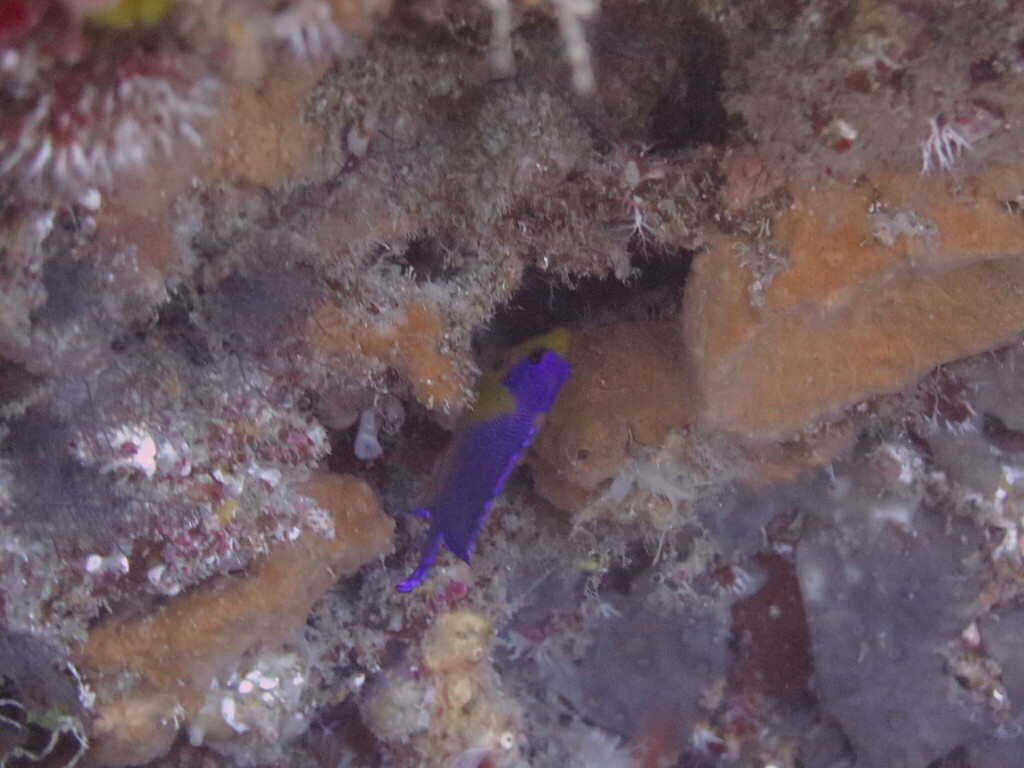
The Blue-backed angelfish (Centropyge venusta) is a saltwater fish of the family Pomacanthidae that grows up to 12 cm.
Description
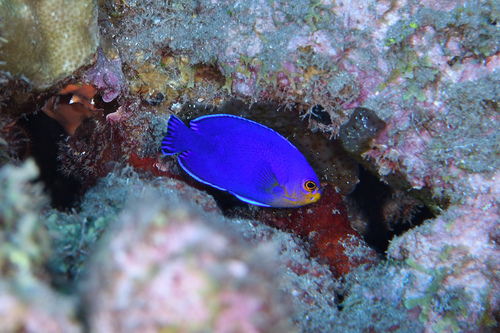
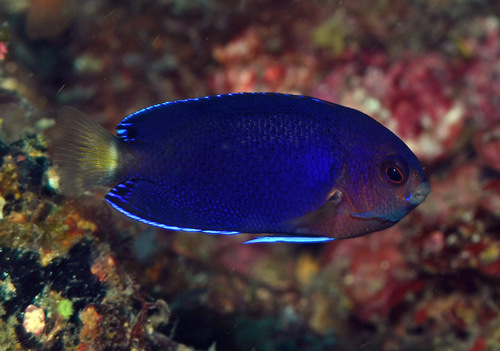
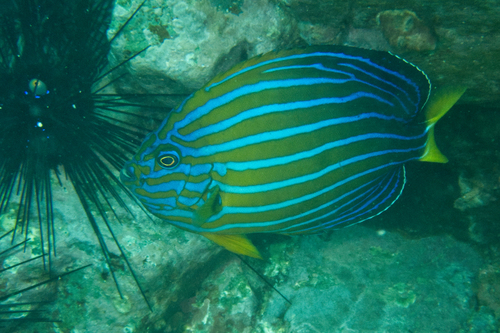
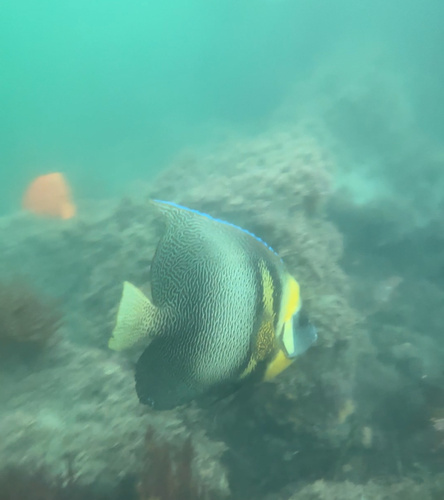
The purplemask angelfish is a small, handsomely coloured marine angelfish from the northwest Pacific, around Japan, Taiwan and the Philippines. The species grows to about 12 cm and has a yellow lower body and a deep-blue back and rear. On the gill cover it bears a strong spine. As a shy reef-dweller it stays close to crevices and caves on steep reef slopes and grazes algae and small invertebrates. It is a protogynous hermaphrodite. The fish appears in the reef aquarium. The IUCN assesses the species as Least Concern (LC).
Frequently asked questions
How do you recognise the Blue-backed angelfish?
The Blue-backed angelfish has a flattened, disc-shaped body, is mainly blue and shows a plain pattern.
Where does the Blue-backed angelfish live?
The Blue-backed angelfish lives in the sea (marine waters) and is mostly found around stony or rocky ground.
How big does the Blue-backed angelfish get?
The Blue-backed angelfish grows to a maximum of about 12 cm.
Is the Blue-backed angelfish dangerous to humans?
No, the Blue-backed angelfish is harmless to humans.
Is the Blue-backed angelfish edible?
The Blue-backed angelfish is not usually eaten.
Download Fin's Fish Guide
Identify fish in seconds, log your catches and dives. Join the TestFlight beta.
All data
Identification
Appearance
Habitat & distribution
Behaviour & biology
For anglers
Safety
Status & sources
Same genus Centropyge
More from the family Pomacanthidae
Download Fin's Fish Guide
Identify fish in seconds, log your catches and dives. Join the TestFlight beta.