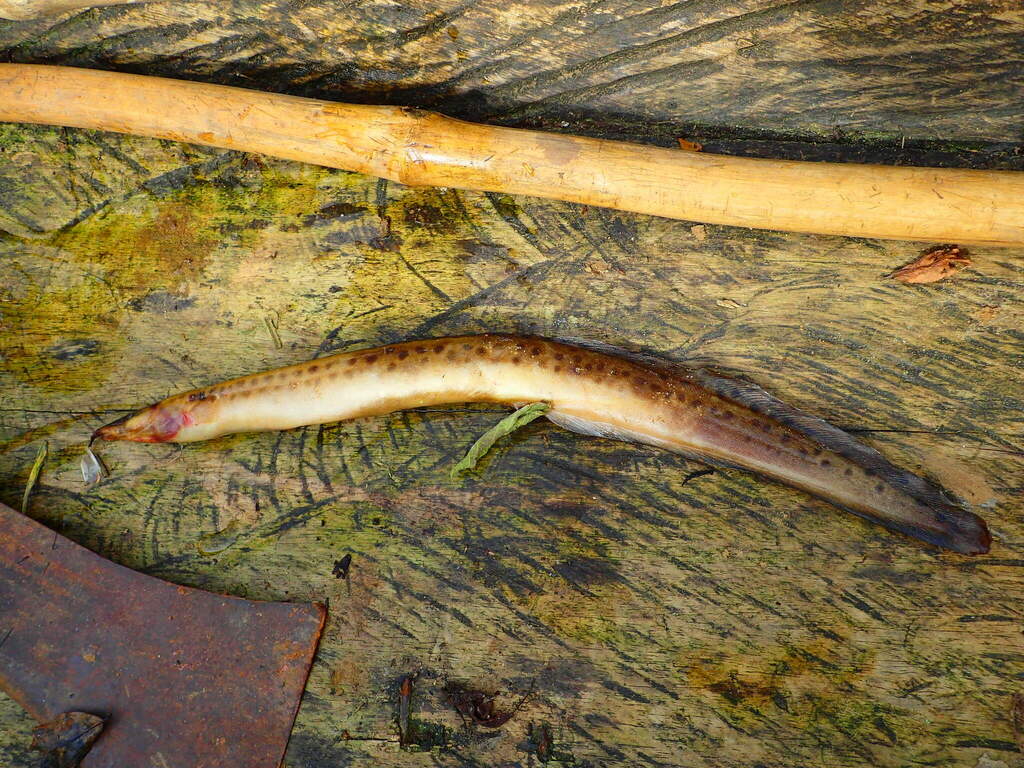

The Mastacembelus seiteri is a freshwater fish of the family Mastacembelidae that grows up to 37 cm.

Want the complete picture on the Mastacembelus seiteri?
Description
Seiter's spiny eel is a spiny eel endemic to Lake Tanganyika in East Africa. The species grows to about 37 cm and has a strongly elongate, eel-like body with an extended snout and a row of separate spinelets before the dorsal fin. As a nocturnal bottom-dweller it shelters by day among rocks and in crevices and searches at night for insect larvae, worms and small invertebrates. The fish is harmless to humans. The IUCN assesses the species as Least Concern (LC).
Frequently asked questions
How do you recognise the Mastacembelus seiteri?
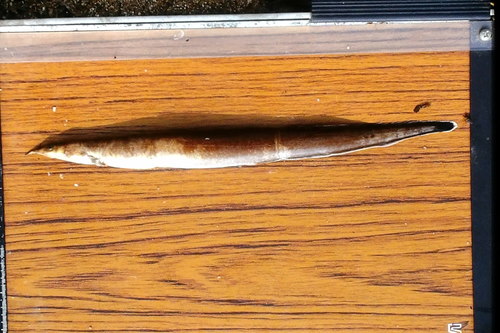
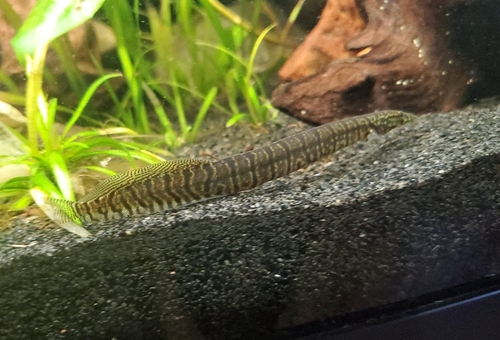
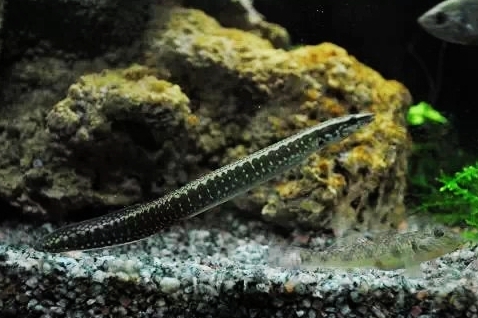
The Mastacembelus seiteri has a snake-like body, is mainly brown and shows a marbled pattern. Elongated snout and separate small dorsal spines; nocturnal rock spiny eel
Where does the Mastacembelus seiteri live?
The Mastacembelus seiteri lives in fresh water and is mostly found around sand or mud bottom. Lake Tanganyika (endemic)
How big does the Mastacembelus seiteri get?
The Mastacembelus seiteri grows to a maximum of about 37 cm.
Is the Mastacembelus seiteri dangerous to humans?
No, the Mastacembelus seiteri is harmless to humans. This species is harmless to humans. No specific first aid is needed. Still handle the fish with care: mind the fin rays and the sharp edges of the gill cover, and rinse any scratch with clean water and cover it. For a dirty or deep wound check tetanus status.
Is the Mastacembelus seiteri edible?
The Mastacembelus seiteri is rarely eaten.
Want the complete picture on the Mastacembelus seiteri?
Point your camera at the fish and Fin names the species in seconds. Free, and the Mastacembelus seiteri is one of 12,519 species in the app.
 Or scan with your phone
All data
Identification
Appearance
Habitat & distribution
Behaviour & biology
For anglers
Safety
Status & sources
Same genus Mastacembelus


More from the family Mastacembelidae
Want the complete picture on the Mastacembelus seiteri?
Point your camera at the fish and Fin names the species in seconds. Free, and the Mastacembelus seiteri is one of 12,519 species in the app.
Or scan with your phone