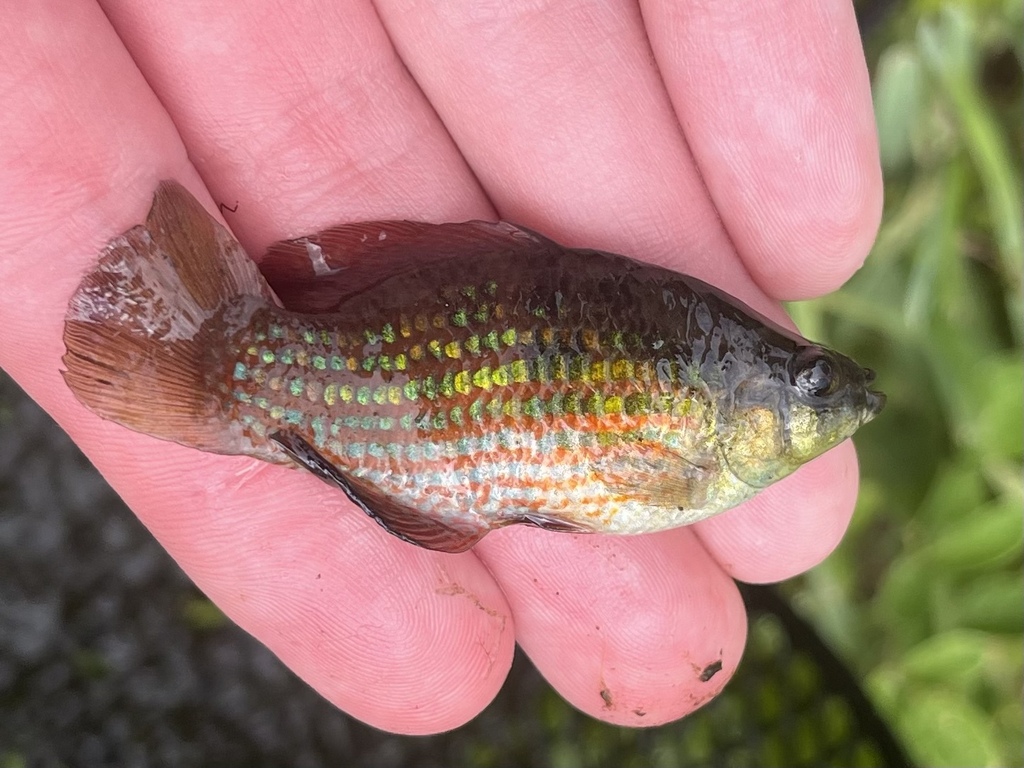
The American Flagfish (Jordanella floridae) is a brackish-water fish of the family Cyprinodontidae that grows up to 6 cm.
Description
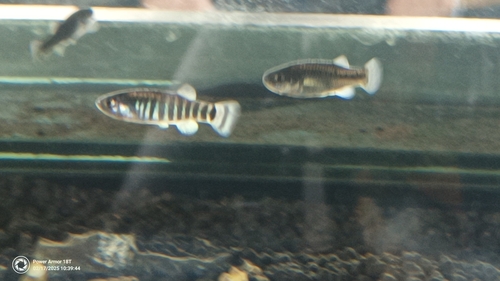
The American flagfish is a small egg-laying fish of the family Cyprinodontidae, endemic to Florida. The male is brightly coloured with alternating green and red longitudinal rows of spots and a dark side blotch, a pattern reminiscent of a flag; females are duller. The fish grows to only about 6 cm and inhabits vegetated sloughs, ponds, lakes and sluggish streams, and also enters brackish water. It is an omnivore eating worms, crustaceans, insects, algae and plant matter. The male guards the eggs. The species is widely kept as an aquarium fish and is not a seasonal killifish.
Frequently asked questions
How do you recognise the American Flagfish?
The American Flagfish has a torpedo-shaped body, is mainly green and shows a horizontal stripes pattern.
Where does the American Flagfish live?
The American Flagfish lives in brackish water and is mostly found around mixed bottom.
How big does the American Flagfish get?
The American Flagfish grows to a maximum of about 6 cm.
Is the American Flagfish dangerous to humans?
No, the American Flagfish is harmless to humans.
Is the American Flagfish edible?
The American Flagfish is not usually eaten.
Download Fin's Fish Guide
Identify fish in seconds, log your catches and dives. Join the TestFlight beta.
All data
Identification
Appearance
Habitat & distribution
Behaviour & biology
For anglers
Safety
Status & sources
More from the family Cyprinodontidae

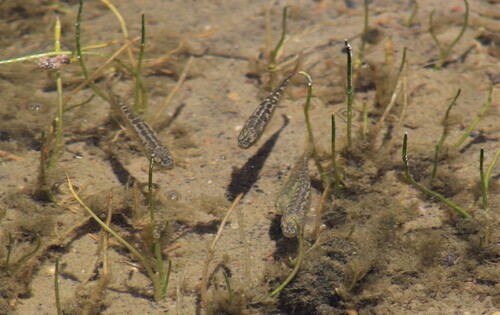
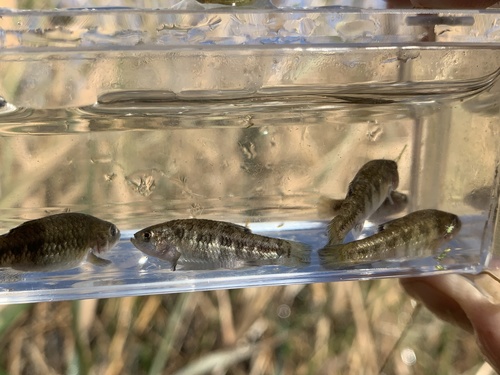


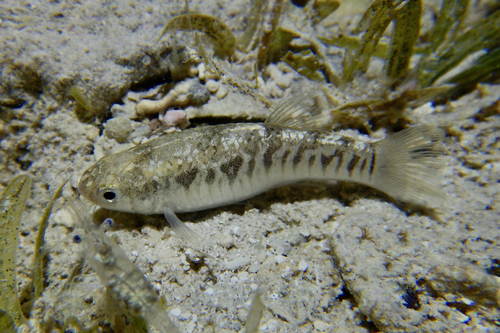
Download Fin's Fish Guide
Identify fish in seconds, log your catches and dives. Join the TestFlight beta.