

The Horseman's corydoras (Corydoras eques) is a freshwater fish of the family Callichthyidae that grows up to 5 cm.

Want the complete picture on the Horseman's corydoras?
Description
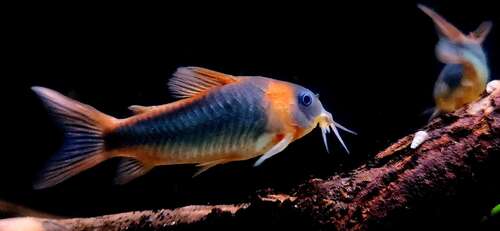
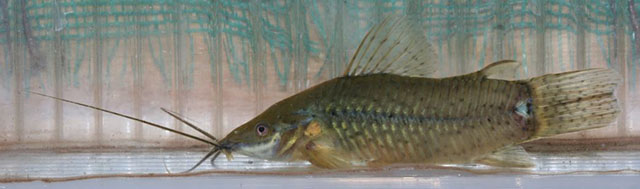
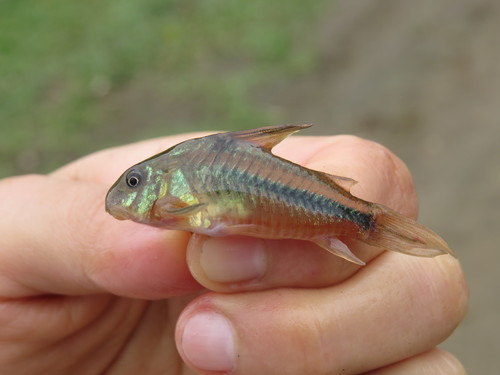
The Horseman's corydoras is a small armoured catfish (Callichthyidae) from fresh water of the western Amazon basin in Brazil. The species grows to about 5 cm and has a stocky body with two rows of overlapping bony plates and three pairs of barbels around an underslung mouth. The body has an orange-red tinge with a green flank patch. As a gregarious bottom-dweller it roots in groups through soft sand in search of worms, larvae and detritus and can take a gulp of air at the surface. The fish is harmless to humans and is popular in the aquarium trade.
Frequently asked questions
How do you recognise the Horseman's corydoras?
The Horseman's corydoras has an elongate, eel-like body, is mainly brown and shows a spots pattern.
Where does the Horseman's corydoras live?
The Horseman's corydoras lives in fresh water and is mostly found around sand or mud bottom. South America: Brazil
How big does the Horseman's corydoras get?
The Horseman's corydoras grows to a maximum of about 5 cm.
Is the Horseman's corydoras dangerous to humans?
No, the Horseman's corydoras is harmless to humans. This species is harmless to humans. No specific first aid is needed. Still handle the fish with care: mind the fin rays and the sharp edges of the gill cover, and rinse any scratch with clean water and cover it. For a dirty or deep wound check tetanus status.
More photos



Want the complete picture on the Horseman's corydoras?
Point your camera at the fish and Fin names the species in seconds. Free, and the Horseman's corydoras is one of 12,519 species in the app.
 Or scan with your phone
All data
Identification
Appearance
Habitat & distribution
Behaviour & biology
For anglers
Safety
Status & sources
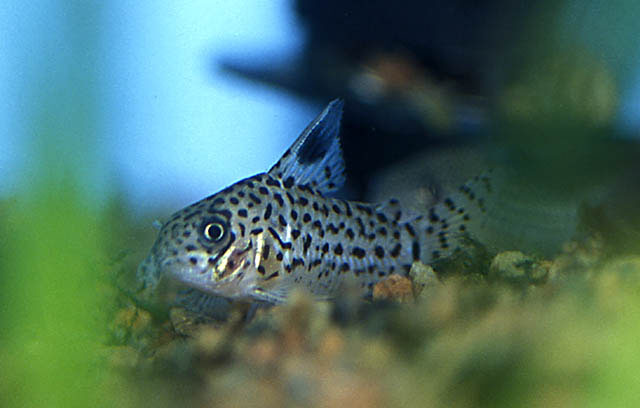
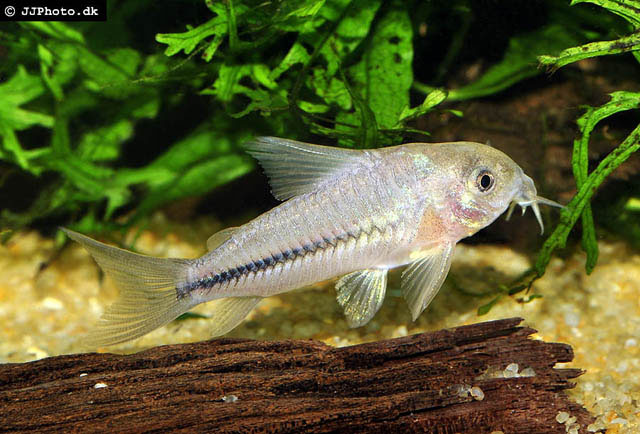
Same genus Corydoras
More from the family Callichthyidae



Want the complete picture on the Horseman's corydoras?
Point your camera at the fish and Fin names the species in seconds. Free, and the Horseman's corydoras is one of 12,519 species in the app.
Or scan with your phone