

The Highfin coral trout (Plectropomus oligacanthus) is a saltwater fish of the family Serranidae that grows up to 75 cm.
Oceania: Australia, Solomon Is., Cambodia, China, Hong Kong, Indonesia and others

Want the complete picture on the Highfin coral trout?
Description
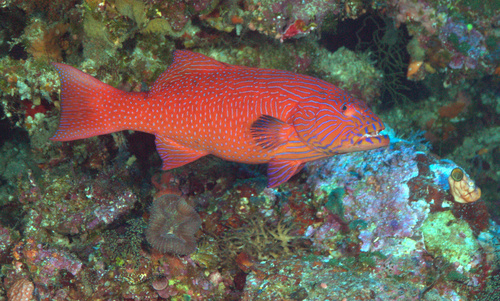
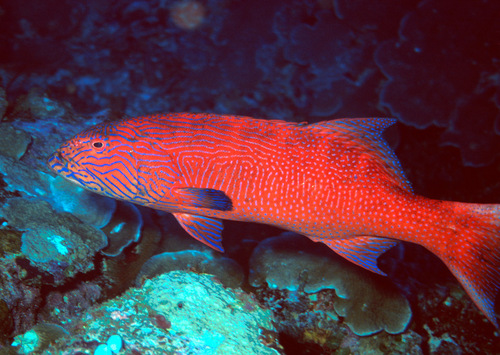
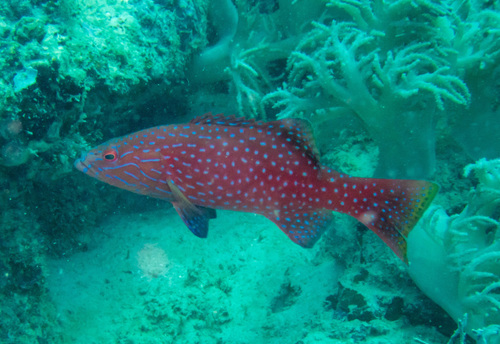
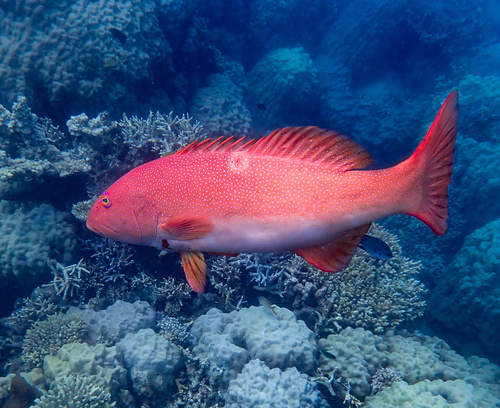
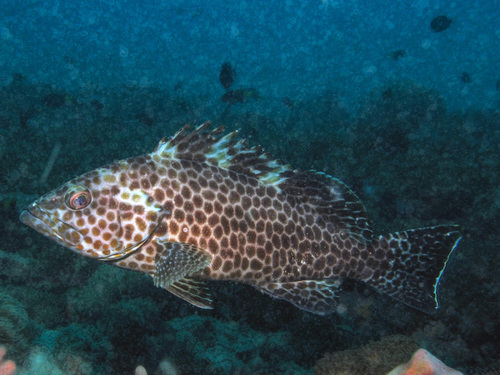
The highfin coral trout is a large grouper (Epinephelidae) from the western Pacific. The species grows to about 75 cm and has a red-brown body studded with blue spots and lines. As a fast reef predator it actively hunts small fish and crustaceans by day. Although a valued food fish, large coral trout are among the known ciguatera carriers and large specimens should not be eaten. The fish is harmless to humans in contact.
Frequently asked questions
How do you recognise the Highfin coral trout?
The Highfin coral trout has a torpedo-shaped body, is mainly red-orange and shows a spots pattern. Bears venomous spines or tissue; handle with great care.
Where does the Highfin coral trout live?
The Highfin coral trout lives in the sea (marine waters) and is mostly found around stony or rocky ground. Oceania: Australia, Solomon Is., Cambodia, China, Hong Kong, Indonesia and others
How big does the Highfin coral trout get?
The Highfin coral trout grows to a maximum of about 75 cm.
Is the Highfin coral trout dangerous to humans?
The Highfin coral trout is venomous — handle spines with care and seek medical help after a sting if needed. Large specimens of this reef predator can carry ciguatera, a food-chain toxin not destroyed by cooking; do not eat large individuals. For poisoning (tingling, reversed hot-cold sensation, gastrointestinal symptoms): seek medical help.
Is the Highfin coral trout edible?
The Highfin coral trout is not usually eaten.
More photos

Want the complete picture on the Highfin coral trout?
Point your camera at the fish and Fin names the species in seconds. Free, and the Highfin coral trout is one of 12,519 species in the app.
 Or scan with your phone
All data
Identification
Appearance
Habitat & distribution
Behaviour & biology
For anglers
Safety
Status & sources
Same genus Plectropomus



More from the family Serranidae



Want the complete picture on the Highfin coral trout?
Point your camera at the fish and Fin names the species in seconds. Free, and the Highfin coral trout is one of 12,519 species in the app.
Or scan with your phone