 Fin's Fish Guide
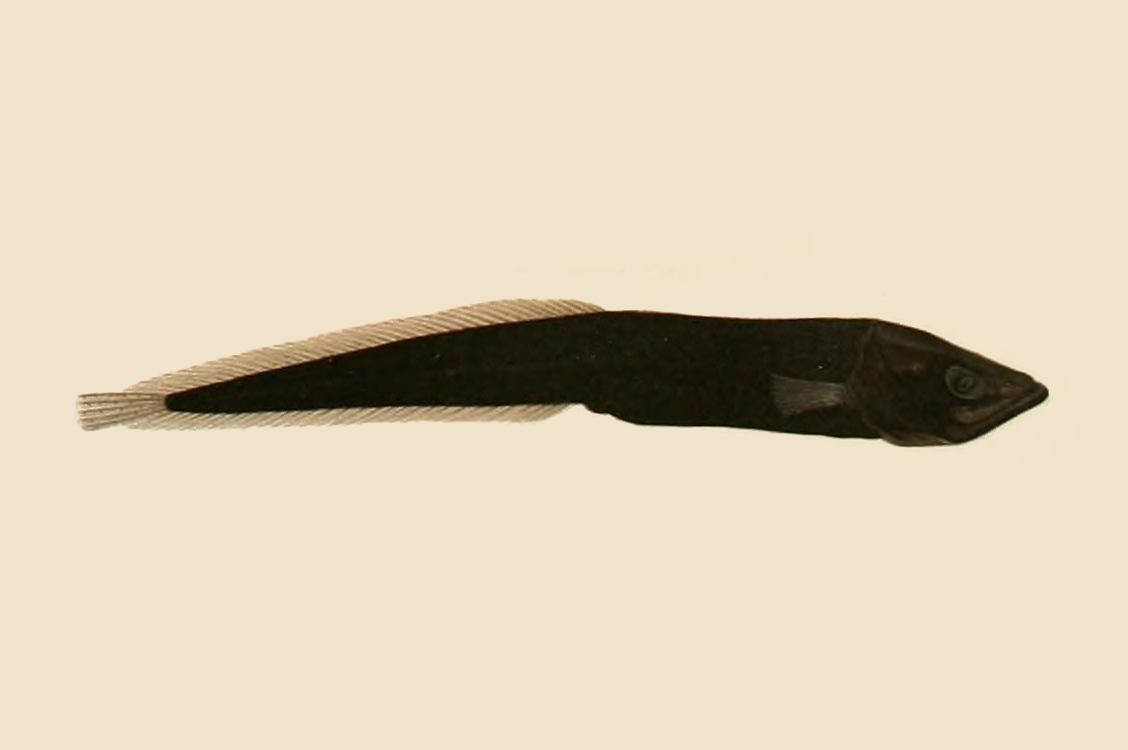

The False cusk (Parabrotula plagiophthalma) is a saltwater fish of the family Parabrotulidae that grows up to 5 cm.
Description
The false cusk is a very small, flabby deep-sea fish of the family Parabrotulidae reaching about 5 cm. The elongate, jelly-like body is dark and has a continuous fin fringe in which the dorsal, tail and anal fins merge; true pelvic fins are absent. Unlike most brotulas, which live on the bottom, this species hovers in the open water of the deep sea worldwide, including the Atlantic, from the surface to several thousand metres. It feeds on small zooplankton. Notably, it is a livebearer, with internal fertilisation. Because of its small size and life in the deep open water it is rarely observed and has no fishery importance.
Frequently asked questions
How do you recognise the False cusk?
The False cusk has a snake-like body, is mainly black and shows a plain pattern. Very small, flabby deep-sea fish with a continuous fin fold and jelly-like skin; lives ovoviviparously, drifting in open water.
Where does the False cusk live?
The False cusk lives in the sea (marine waters) and is mostly found around open water. Worldwide in the deep sea, meso- to bathypelagic in open water.
How big does the False cusk get?
The False cusk grows to a maximum of about 5 cm.
Is the False cusk dangerous to humans?
No, the False cusk is harmless to humans. None required: this species is harmless to humans.
Is the False cusk edible?
The False cusk is not usually eaten.
Want the complete picture on the False cusk?
Point your camera at the fish and Fin names the species in seconds. Free, and the False cusk is one of 12,519 species in the app.
 Or scan with your phone
All data
Identification
Appearance
Habitat & distribution
Behaviour & biology
For anglers
Safety
Status & sources
Want the complete picture on the False cusk?
Point your camera at the fish and Fin names the species in seconds. Free, and the False cusk is one of 12,519 species in the app.
Or scan with your phone