 Fin's Fish Guide
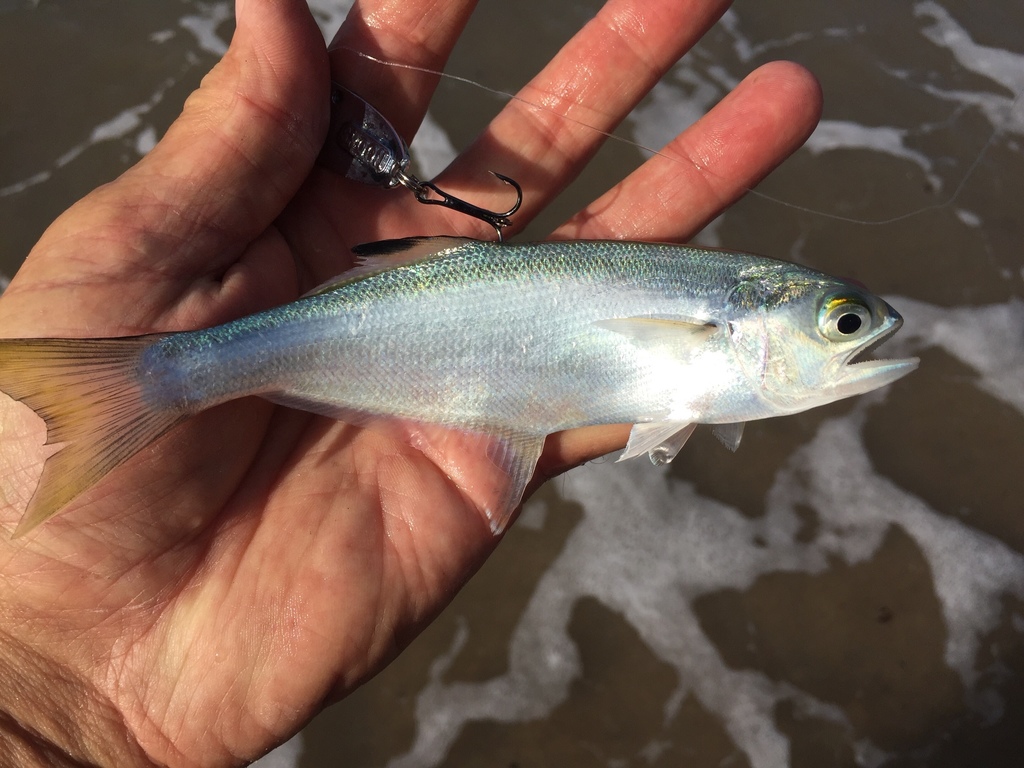

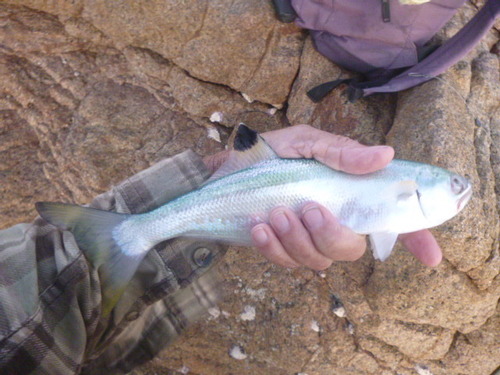
The Beach salmon (Leptobrama muelleri) is a fish that lives in both fresh and salt water of the family Leptobramidae that grows up to 38 cm.
Indo-West Pacific; coastal waters and estuaries of northern Australia and New Guinea.
Description
The beachsalmon is a coastal fish of the family Leptobramidae from the Indo-West Pacific around northern Australia and New Guinea, the only species of its family. The species grows to about 38 cm and has a silvery, laterally compressed body with large eyes, adapted to turbid water and twilight. It lives inshore and enters the lower reaches of rivers and estuaries into brackish water. As a predator it hunts, mainly at dusk, small fishes and crustaceans. The beachsalmon is a valued table and angling fish within its range. It is harmless to humans.
Frequently asked questions
How do you recognise the Beach salmon?
The Beach salmon has a torpedo-shaped body, is mainly silver-grey and shows a plain pattern. The only species of its family; large eyes for turbid, dim water, moves into estuaries.
Where does the Beach salmon live?
The Beach salmon lives in both fresh and salt water and is mostly found around open water. Indo-West Pacific; coastal waters and estuaries of northern Australia and New Guinea.
How big does the Beach salmon get?
The Beach salmon grows to a maximum of about 38 cm.
Is the Beach salmon dangerous to humans?
No, the Beach salmon is harmless to humans. None required: this species is harmless to humans.
Is the Beach salmon edible?
Yes, the Beach salmon is commonly eaten.
More photos


Want the complete picture on the Beach salmon?
Point your camera at the fish and Fin names the species in seconds. Free, and the Beach salmon is one of 12,519 species in the app.
 Or scan with your phone
All data
Identification
Appearance
Habitat & distribution
Behaviour & biology
For anglers
Safety
Status & sources
Want the complete picture on the Beach salmon?
Point your camera at the fish and Fin names the species in seconds. Free, and the Beach salmon is one of 12,519 species in the app.
Or scan with your phone