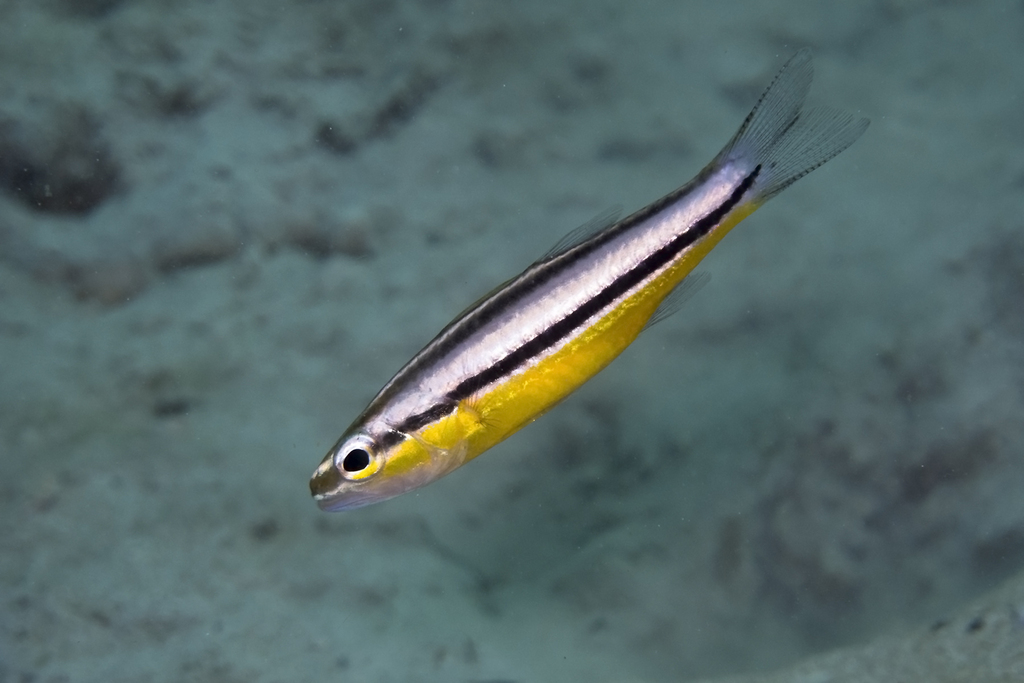

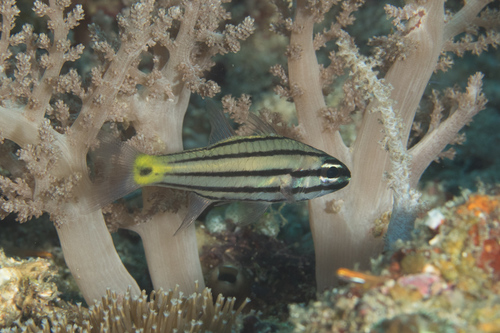
The Banded toothy cardinalfish (Cheilodipterus zonatus) is a saltwater fish of the family Apogonidae that grows up to 8 cm.
Oceania: Solomon Is., Fiji, Indonesia, Malaysia, Papua New Guinea, Philippines

Want the complete picture on the Banded toothy cardinalfish?
Description
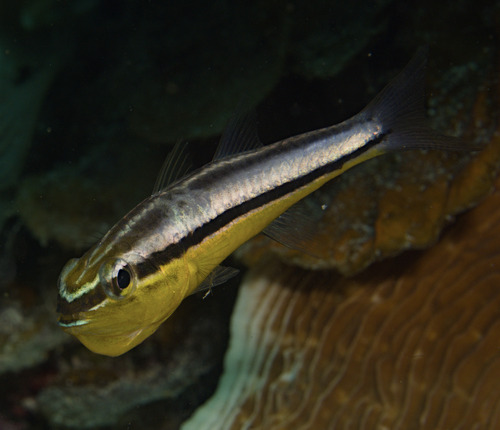
The banded toothy cardinalfish is a cardinalfish (Apogonidae) from reef water of the Indo-West Pacific. The species grows to about 10 cm and has a slender, yellow-white body with dark longitudinal stripes, large eyes and, unlike many cardinalfish, prominent canine teeth. As a nocturnal fish it shelters by day among coral and hunts small fish and crustaceans by night. The male broods the eggs in his mouth. The fish is harmless to humans.
Frequently asked questions
How do you recognise the Banded toothy cardinalfish?
The Banded toothy cardinalfish has an elongate, eel-like body, is mainly yellow-gold and shows a horizontal stripes pattern.
Where does the Banded toothy cardinalfish live?
The Banded toothy cardinalfish lives in the sea (marine waters) and is mostly found around stony or rocky ground. Oceania: Solomon Is., Fiji, Indonesia, Malaysia, Papua New Guinea, Philippines
How big does the Banded toothy cardinalfish get?
The Banded toothy cardinalfish grows to a maximum of about 8 cm.
Is the Banded toothy cardinalfish dangerous to humans?
No, the Banded toothy cardinalfish is harmless to humans. This species is harmless to humans. No specific first aid is needed. Still handle the fish with care: mind the fin rays and the sharp edges of the gill cover, and rinse any scratch with clean water and cover it. For a dirty or deep wound check tetanus status.
More photos
Want the complete picture on the Banded toothy cardinalfish?
Point your camera at the fish and Fin names the species in seconds. Free, and the Banded toothy cardinalfish is one of 12,519 species in the app.
 Or scan with your phone
All data
Identification
Appearance
Habitat & distribution
Behaviour & biology
For anglers
Safety
Status & sources
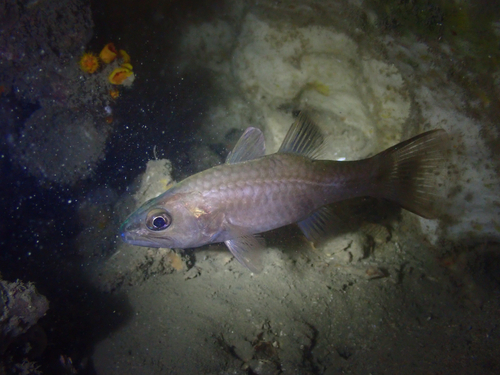
Same genus Cheilodipterus


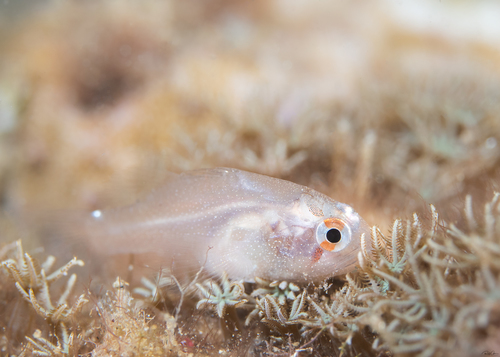
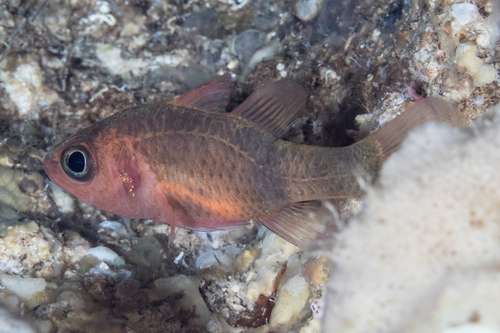
More from the family Apogonidae

Want the complete picture on the Banded toothy cardinalfish?
Point your camera at the fish and Fin names the species in seconds. Free, and the Banded toothy cardinalfish is one of 12,519 species in the app.
Or scan with your phone