 Fin's Fish Guide


The Atlantic sturgeon (Acipenser oxyrinchus) is a fish that lives in both fresh and salt water of the family Acipenseridae that grows up to 403 cm.
North America: Bermuda, Canada, French Guiana, Mexico, St Pierre Mique., USA
Description
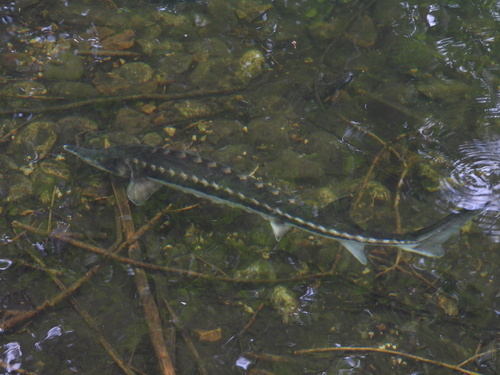
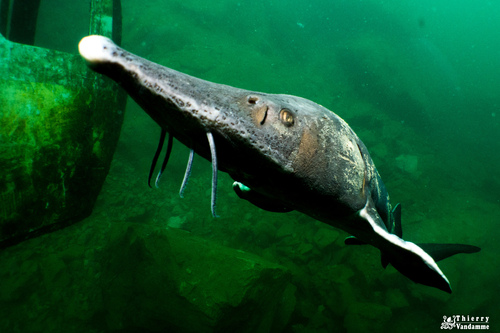
The Atlantic sturgeon is a large, anadromous fish with an elongate body that bears five rows of bony plates instead of scales. Beneath its pointed snout are four barbels and a downward-pointing, protrusible mouth used to search the bottom for prey. It feeds on benthic animals such as worms, molluscs and crustaceans. Adults live on the continental shelf and in estuaries and ascend rivers to spawn. The species can become very old and, at over four metres, exceptionally large. Owing to overfishing it is assessed as Vulnerable (VU).
Frequently asked questions
How do you recognise the Atlantic sturgeon?
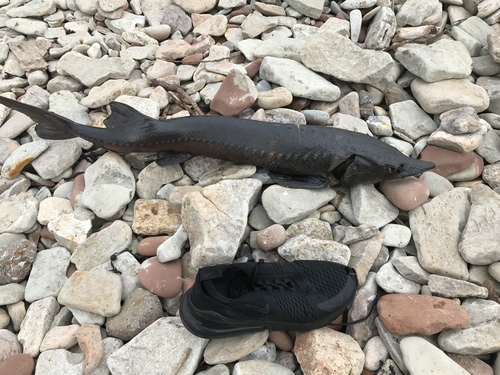
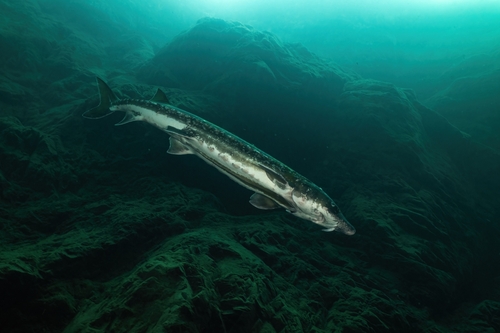
The Atlantic sturgeon has an elongate, eel-like body, is mainly brown and shows a plain pattern. Five rows of bony plates, four chin barbels and a protrusible inferior mouth.
Where does the Atlantic sturgeon live?
The Atlantic sturgeon lives in both fresh and salt water and is mostly found around sand or mud bottom. North America: Bermuda, Canada, French Guiana, Mexico, St Pierre Mique., USA
How big does the Atlantic sturgeon get?
The Atlantic sturgeon grows to a maximum of about 403 cm.
Is the Atlantic sturgeon dangerous to humans?
No, the Atlantic sturgeon is harmless to humans. This species is harmless to humans. No specific first aid is needed. Still handle the fish with care: mind the fin rays and the sharp edges of the gill cover, and rinse any scratch with clean water and cover it. For a dirty or deep wound check tetanus status.
Is the Atlantic sturgeon edible?
Yes, the Atlantic sturgeon is commonly eaten.
More photos


Easily confused with
These species look like the Atlantic sturgeon and live in the same waters.

Want the complete picture on the Atlantic sturgeon?
Point your camera at the fish and Fin names the species in seconds. Free, and the Atlantic sturgeon is one of 12,519 species in the app.
 Or scan with your phone
All data
Identification
Appearance
Habitat & distribution
Behaviour & biology
For anglers
Safety
Status & sources
Same genus Acipenser



More from the family Acipenseridae
Want the complete picture on the Atlantic sturgeon?
Point your camera at the fish and Fin names the species in seconds. Free, and the Atlantic sturgeon is one of 12,519 species in the app.
Or scan with your phone