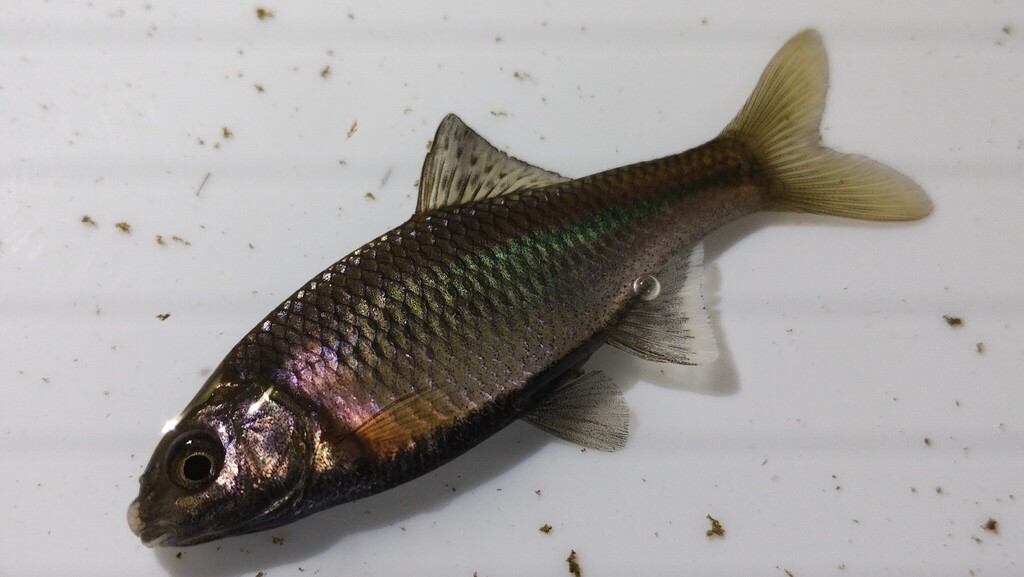
The Japanese bitterling (Acheilognathus melanogaster) is a freshwater fish of the family Cyprinidae that grows up to 5 cm.
Description
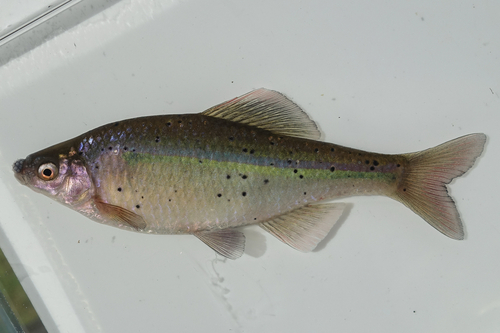
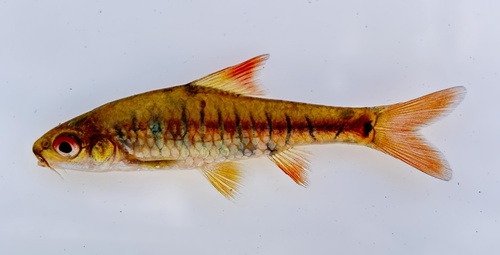
The Japanese bitterling is a small, deep-bodied cyprinid of the family Acheilognathidae (bitterlings) reaching about 5 cm. The compressed, silvery body has a dark lengthwise stripe; breeding males colour up vividly with yellowish and dark tints. Characteristic is the special reproduction: the female develops a long ovipositor and lays the eggs in the gill cavity of a living freshwater mussel, where the larvae grow up sheltered - a partnership between fish and mussel. The species comes from Japan and lives in clear ponds, lakes and slow-flowing streams where such mussels occur. It eats algae, zooplankton, insect larvae and detritus. It is popular in the coldwater aquarium hobby.
Frequently asked questions
How do you recognise the Japanese bitterling?
The Japanese bitterling has an elongate, eel-like body, is mainly silver-grey and shows a horizontal stripes pattern.
Where does the Japanese bitterling live?
The Japanese bitterling lives in fresh water and is mostly found around algae or seagrass beds.
How big does the Japanese bitterling get?
The Japanese bitterling grows to a maximum of about 5 cm.
Is the Japanese bitterling dangerous to humans?
No, the Japanese bitterling is harmless to humans.
Is the Japanese bitterling edible?
The Japanese bitterling is not usually eaten.
Download Fin's Fish Guide
Identify fish in seconds, log your catches and dives. Join the TestFlight beta.
All data
Identification
Appearance
Habitat & distribution
Behaviour & biology
For anglers
Safety
Status & sources
Same genus Acheilognathus

More from the family Cyprinidae


Download Fin's Fish Guide
Identify fish in seconds, log your catches and dives. Join the TestFlight beta.