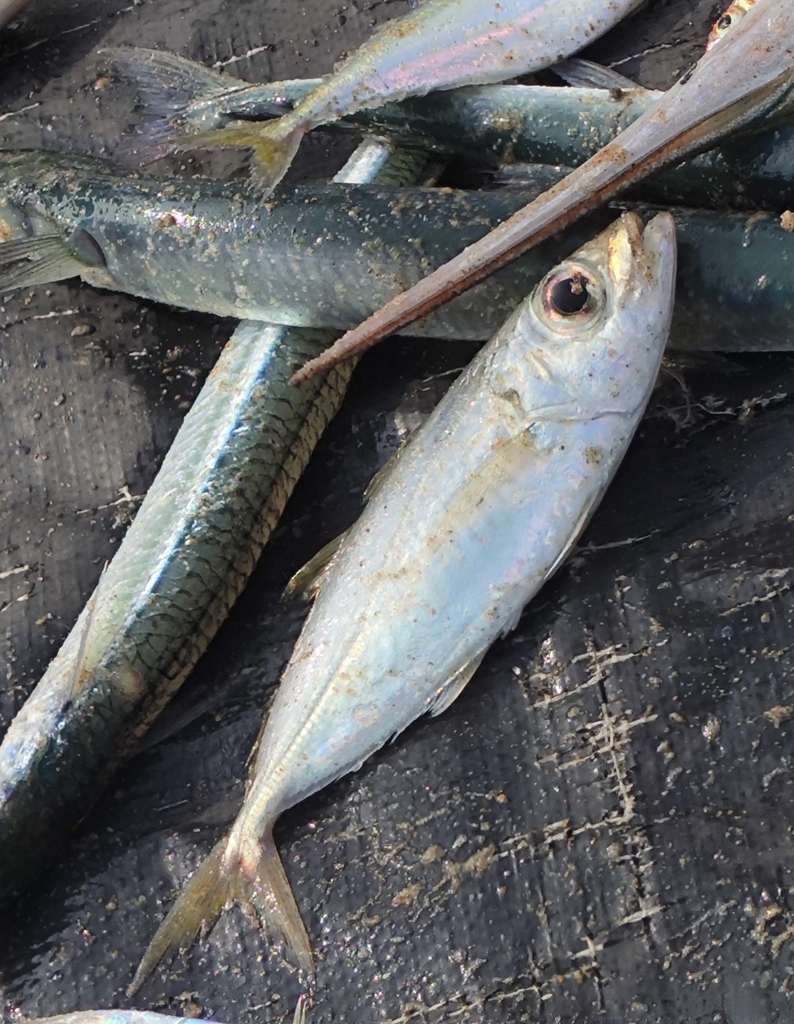
The Bigeye scad (Selar crumenophthalmus) is a saltwater fish of the family Carangidae that grows up to 70 cm.
Description
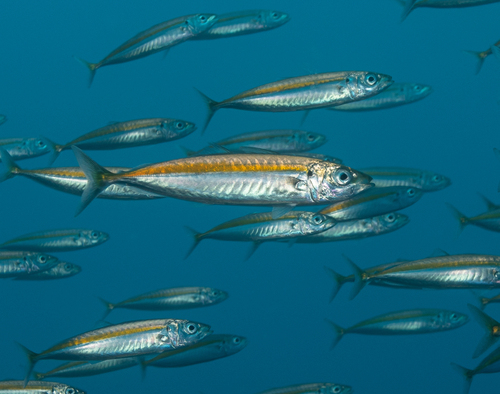
The bigeye scad is a slender jack of the family Carangidae reaching about 70 cm, though usually smaller. The silvery, torpedo-shaped body stands out for very large eyes, adapted to hunting at night; along the caudal peduncle run the hard scutes typical of jacks. The species is naturally circumtropical in the Indo-Pacific and Atlantic, but has entered the eastern Mediterranean as a Lessepsian migrant through the Suez Canal, where it has become established. In night-active schools it feeds on zooplankton, small fish and crustaceans. Locally it is a valued commercial fish eaten fresh or dried.
Frequently asked questions
How do you recognise the Bigeye scad?
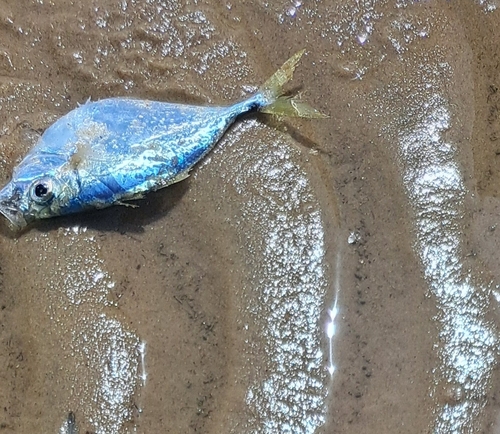
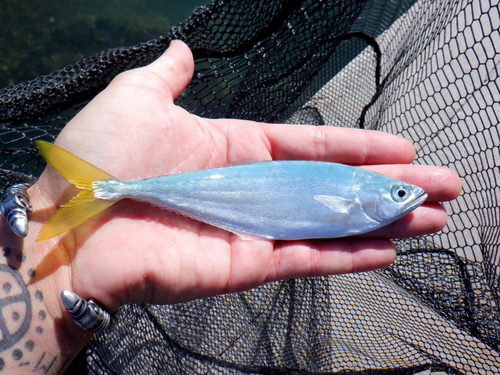
The Bigeye scad has a torpedo-shaped body, is mainly silver-grey and shows a plain pattern.
Where does the Bigeye scad live?
The Bigeye scad lives in the sea (marine waters) and is mostly found around open water.
How big does the Bigeye scad get?
The Bigeye scad grows to a maximum of about 70 cm.
Is the Bigeye scad dangerous to humans?
No, the Bigeye scad is harmless to humans.
Is the Bigeye scad edible?
Yes, the Bigeye scad is commonly eaten.
Download Fin's Fish Guide
Identify fish in seconds, log your catches and dives. Join the TestFlight beta.
All data
Identification
Appearance
Habitat & distribution
Behaviour & biology
For anglers
Safety
Status & sources
Same genus Selar

More from the family Carangidae

Download Fin's Fish Guide
Identify fish in seconds, log your catches and dives. Join the TestFlight beta.