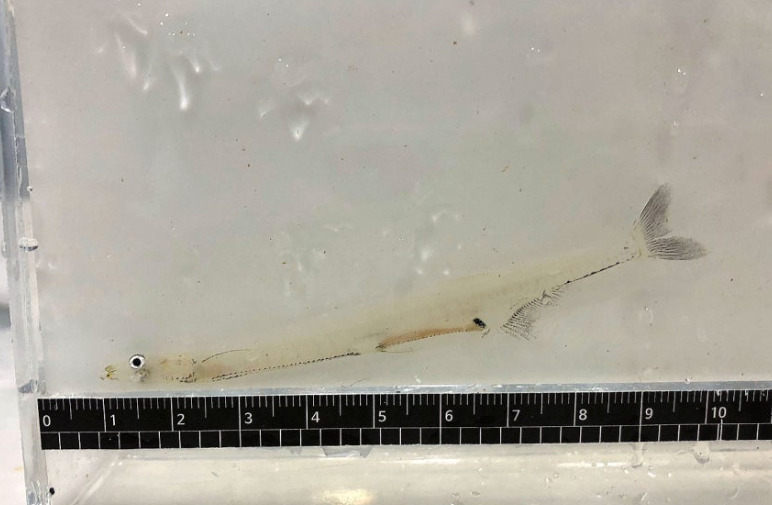
The Common icefish (Salangichthys microdon) is a brackish-water fish of the family Salangidae that grows up to 10 cm.
Description
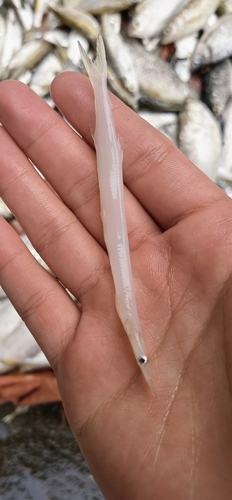
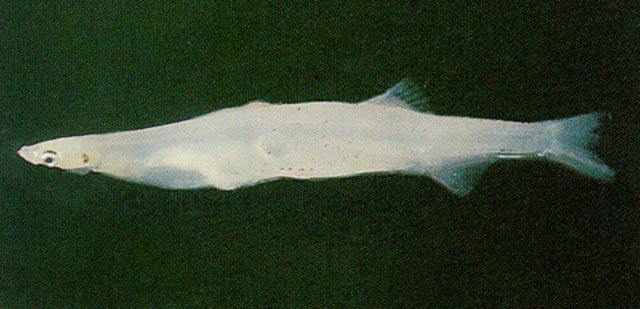
The common icefish or noodlefish is a very slender, almost transparent fish of the family Salangidae (icefishes) reaching about 10 cm. The glass-clear, scaleless body recalls a glass noodle; the species remains larva-like in build throughout life (neoteny) and is almost invisible in the water. It comes from East Asia and lives in coastal and estuarine water around Japan, Korea and the Russian Far East. It is amphidromous: it shuttles between sea, brackish and fresh water and migrates to fresher water to spawn, where most individuals spawn once and then die. In schools it filters small zooplankton. In East Asia it is a valued delicacy, eaten fresh or dried.
Frequently asked questions
How do you recognise the Common icefish?
The Common icefish has an elongate, eel-like body, is mainly white and shows a plain pattern.
Where does the Common icefish live?
The Common icefish lives in brackish water and is mostly found around open water.
How big does the Common icefish get?
The Common icefish grows to a maximum of about 10 cm.
Is the Common icefish dangerous to humans?
No, the Common icefish is harmless to humans.
Is the Common icefish edible?
Yes, the Common icefish is commonly eaten.
Download Fin's Fish Guide
Identify fish in seconds, log your catches and dives. Join the TestFlight beta.
All data
Identification
Appearance
Habitat & distribution
Behaviour & biology
For anglers
Safety
Status & sources
More from the family Salangidae

Download Fin's Fish Guide
Identify fish in seconds, log your catches and dives. Join the TestFlight beta.