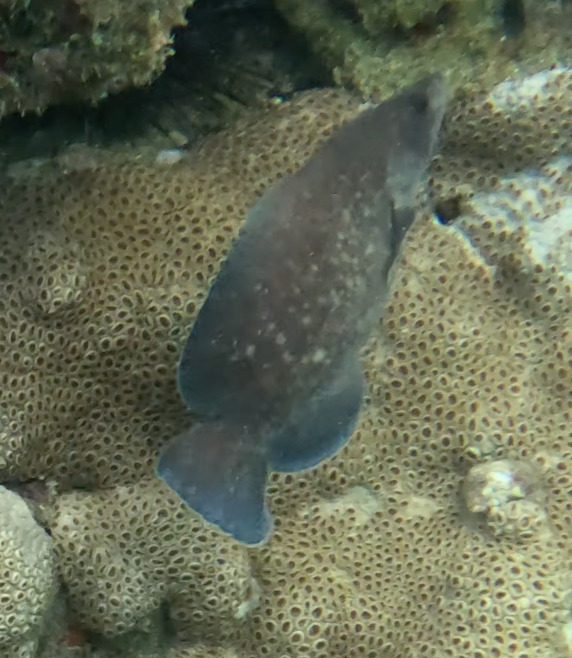
The Greater soapfish (Rypticus saponaceus) is a saltwater fish of the family Serranidae that grows up to 35 cm.
Description
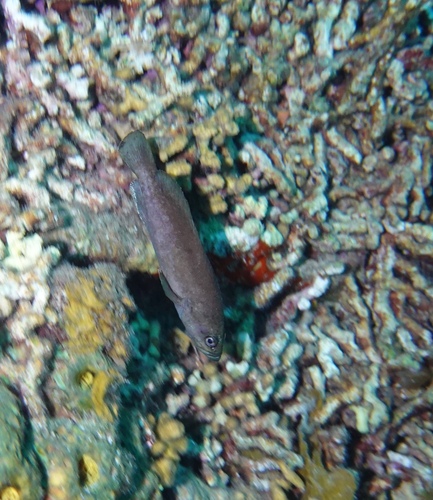
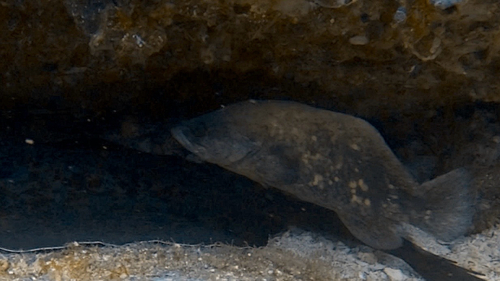
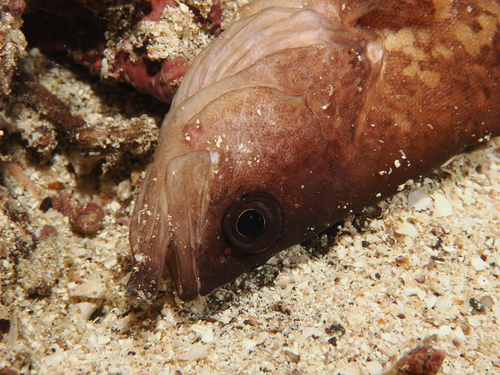
The greater soapfish is a stocky perch-like fish of the family Serranidae reaching about 35 cm. The brown-grey, faintly mottled body has a projecting lower jaw and small, embedded scales. The species owes its name to a remarkable defence: when disturbed the skin secretes a toxic, bitter mucus (grammistin) that whips up into a soapy foam in the water and deters predators. It lives near reefs, rocky bottoms and in crevices of shallow water of the Atlantic on both sides, in the east along West Africa and around the Macaronesian islands. By day it shelters, often head-down or on its side; at night it ambushes fish and crustaceans. Because of the toxic mucus it is not eaten.
Frequently asked questions
How do you recognise the Greater soapfish?
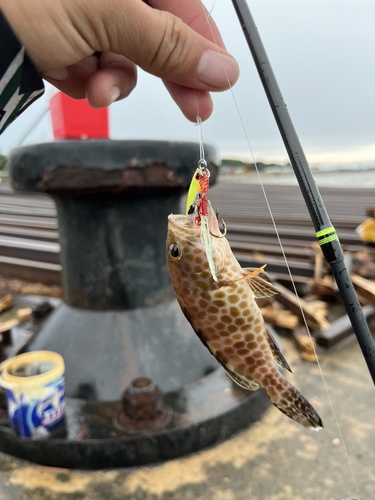
The Greater soapfish has a torpedo-shaped body, is mainly brown and shows a spots pattern.
Where does the Greater soapfish live?
The Greater soapfish lives in the sea (marine waters) and is mostly found around stony or rocky ground.
How big does the Greater soapfish get?
The Greater soapfish grows to a maximum of about 35 cm. On average the species is around 25 cm.
Is the Greater soapfish dangerous to humans?
No, the Greater soapfish is harmless to humans.
Is the Greater soapfish edible?
The Greater soapfish is not usually eaten.
Download Fin's Fish Guide
Identify fish in seconds, log your catches and dives. Join the TestFlight beta.
All data
Identification
Appearance
Habitat & distribution
Behaviour & biology
For anglers
Safety
Status & sources
Same genus Rypticus
More from the family Serranidae


Download Fin's Fish Guide
Identify fish in seconds, log your catches and dives. Join the TestFlight beta.