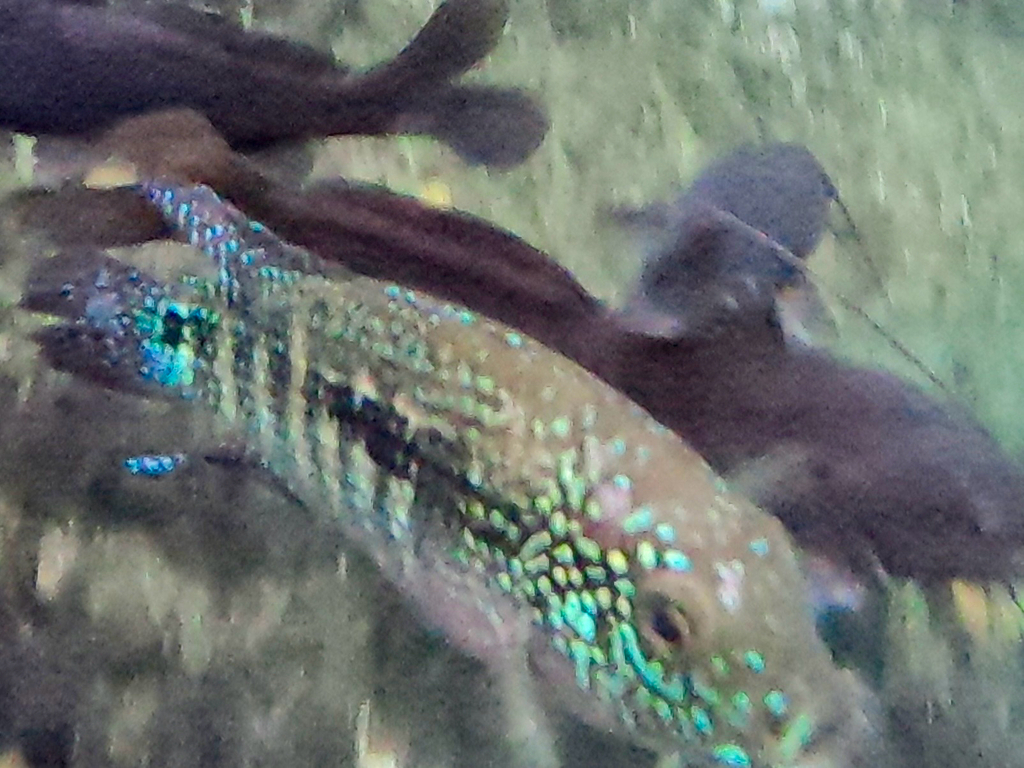
The Jack dempsey (Rocio octofasciata) is a freshwater fish of the family Cichlidae that grows up to 25 cm.
Description
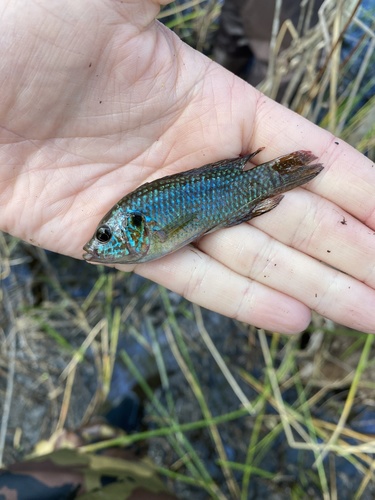
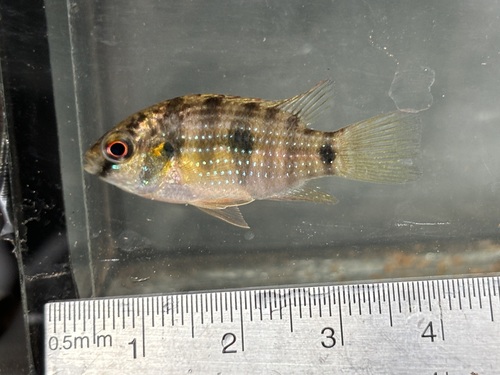
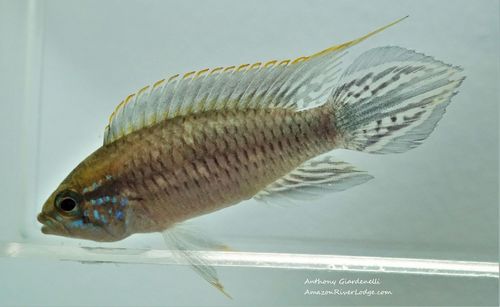
The Jack Dempsey is a colourful cichlid from Central America, named after the boxer for its combative character. The species grows to about 25 cm and has a deep, dark body studded with numerous bright blue-green spots and several dark crossbars. It inhabits swampy areas with warm, murky water and weedy canals and ditches with mud or sand bottoms in lowland rivers. As an omnivore it feeds on worms, insects, crustaceans and small fishes. The species is strongly territorial, especially during brood care, and is popular in the aquarium. It is harmless to humans.
Frequently asked questions
How do you recognise the Jack dempsey?
The Jack dempsey has a flattened, disc-shaped body, is mainly blue and shows a spots pattern.
Where does the Jack dempsey live?
The Jack dempsey lives in fresh water and is mostly found around mixed bottom.
How big does the Jack dempsey get?
The Jack dempsey grows to a maximum of about 25 cm. On average the species is around 8 cm.
Is the Jack dempsey dangerous to humans?
No, the Jack dempsey is harmless to humans.
Is the Jack dempsey edible?
The Jack dempsey is not usually eaten.
Download Fin's Fish Guide
Identify fish in seconds, log your catches and dives. Join the TestFlight beta.
All data
Identification
Appearance
Habitat & distribution
Behaviour & biology
For anglers
Safety
Status & sources
More from the family Cichlidae



Download Fin's Fish Guide
Identify fish in seconds, log your catches and dives. Join the TestFlight beta.