
The Chinese paddlefish (Psephurus gladius) is a fish that lives in both fresh and salt water of the family Polyodontidae that grows up to 300 cm.
Description
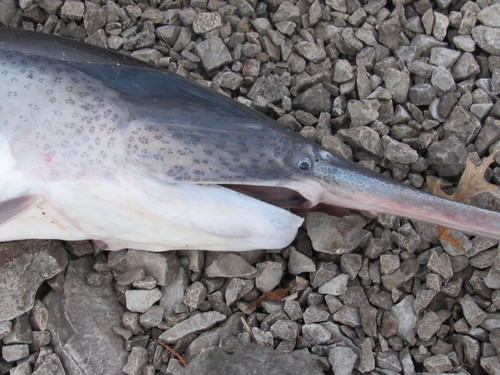
The Chinese paddlefish was one of the largest freshwater fishes in the world, a paddlefish (Polyodontidae) from the Yangtze River system in China. The species could grow to about 3 metres and had a streamlined, scale-poor body with an extraordinarily long, sword-shaped snout full of electric senses, with which it detected prey. As a migratory top predator it hunted fish and crustaceans. Through dams and overfishing it has not been seen since the early part of this century and is considered extinct. To humans it was harmless.
Frequently asked questions
How do you recognise the Chinese paddlefish?
The Chinese paddlefish has an elongate, eel-like body and is mainly silver-grey.
Where does the Chinese paddlefish live?
The Chinese paddlefish lives in both fresh and salt water and is mostly found around sand or mud bottom.
How big does the Chinese paddlefish get?
The Chinese paddlefish grows to a maximum of about 300 cm.
Is the Chinese paddlefish dangerous to humans?
No, the Chinese paddlefish is harmless to humans.
Is the Chinese paddlefish edible?
Yes, the Chinese paddlefish is commonly eaten.
Download Fin's Fish Guide
Identify fish in seconds, log your catches and dives. Join the TestFlight beta.
All data
Identification
Appearance
Habitat & distribution
Behaviour & biology
For anglers
Safety
Status & sources
More from the family Polyodontidae
Download Fin's Fish Guide
Identify fish in seconds, log your catches and dives. Join the TestFlight beta.