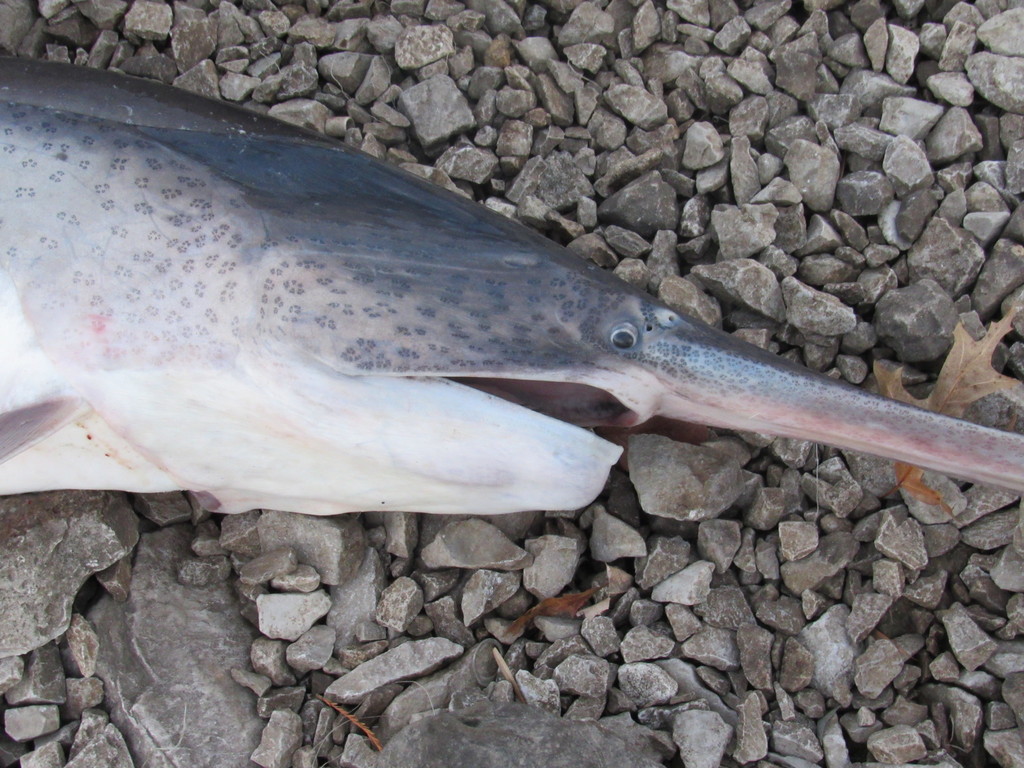
The Duckbill Cat (Polyodon spathula) is a freshwater fish of the family Polyodontidae that grows up to 221 cm.
Description
The American paddlefish is a large, ancient freshwater fish of the family Polyodontidae from the Mississippi basin in North America. The species can reach over two metres and is notable for its greatly elongated, paddle-shaped snout full of sensory cells, with which it detects zooplankton in turbid water. It lives in slow-flowing large rivers, lakes and impoundments, usually in water deeper than a metre. As a filter feeder it swims with open mouth through plankton-rich layers. Owing to overfishing for caviar and flesh and to dams, the species is Vulnerable (VU). It is harmless to humans.
Frequently asked questions
How do you recognise the Duckbill Cat?
The Duckbill Cat has an elongate, eel-like body, is mainly silver-grey and shows a plain pattern.
Where does the Duckbill Cat live?
The Duckbill Cat lives in fresh water and is mostly found around sand or mud bottom.
How big does the Duckbill Cat get?
The Duckbill Cat grows to a maximum of about 221 cm. On average the species is around 120 cm.
Is the Duckbill Cat dangerous to humans?
No, the Duckbill Cat is harmless to humans.
Is the Duckbill Cat edible?
Yes, the Duckbill Cat is commonly eaten.
Download Fin's Fish Guide
Identify fish in seconds, log your catches and dives. Join the TestFlight beta.
All data
Identification
Appearance
Habitat & distribution
Behaviour & biology
For anglers
Safety
Status & sources
More from the family Polyodontidae

Download Fin's Fish Guide
Identify fish in seconds, log your catches and dives. Join the TestFlight beta.