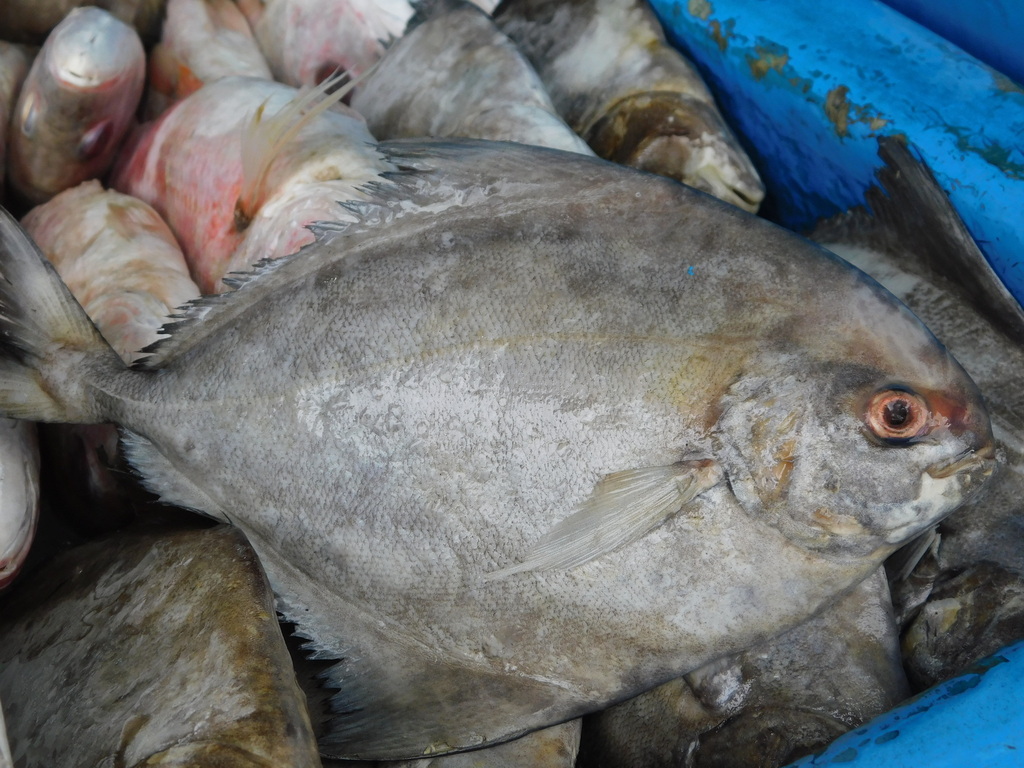
The Black batfish (Parastromateus niger) is a brackish-water fish of the family Carangidae that grows up to 75 cm.
Description
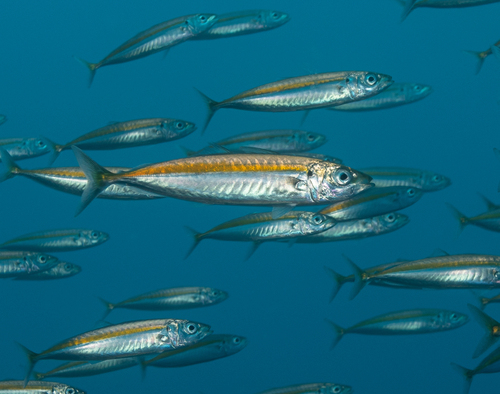
The black pomfret is a jack (Carangidae) of the Indo-Pacific, despite its name not a true pomfret. The species grows to about 75 cm and has a deep, strongly laterally compressed, dark grey-black body with a deeply forked tail. Adults live over muddy coastal bottoms, near the bottom by day and closer to the surface at night, and also enter estuaries; they form large schools. The fish feeds on zooplankton and small invertebrates. The black pomfret is a highly prized food fish with tasty flesh. It is harmless to humans.
Frequently asked questions
How do you recognise the Black batfish?
The Black batfish has a flattened, disc-shaped body, is mainly black and shows a plain pattern.
Where does the Black batfish live?
The Black batfish lives in brackish water and is mostly found around stony or rocky ground.
How big does the Black batfish get?
The Black batfish grows to a maximum of about 75 cm. On average the species is around 30 cm.
Is the Black batfish dangerous to humans?
No, the Black batfish is harmless to humans.
Is the Black batfish edible?
Yes, the Black batfish is a highly prized food fish.
Download Fin's Fish Guide
Identify fish in seconds, log your catches and dives. Join the TestFlight beta.
All data
Identification
Appearance
Habitat & distribution
Behaviour & biology
For anglers
Safety
Status & sources
More from the family Carangidae

Download Fin's Fish Guide
Identify fish in seconds, log your catches and dives. Join the TestFlight beta.