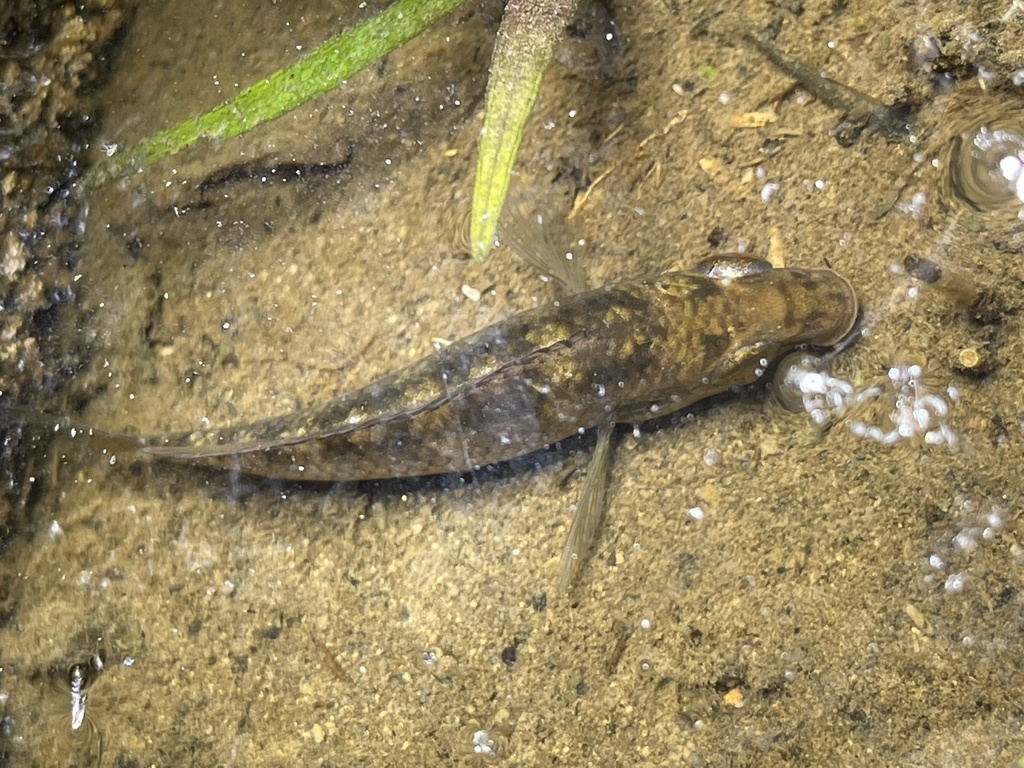
The Bandtail dwarf cichlid (Parananochromis caudifasciatus) is a freshwater fish of the family Cichlidae that grows up to 10 cm.
Description
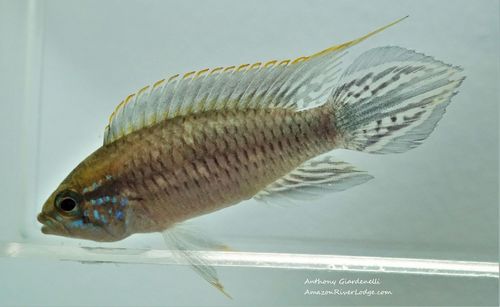
Parananochromis caudifasciatus is a small Central African dwarf cichlid from coastal rivers and rainforest streams of Cameroon, Gabon and surrounding areas. The species has an elongate body and reaches about 10 cm; the species name refers to a band marking on the tail. It lives monogamously in stable pairs and is a biparental substrate spawner: the eggs are laid on a surface and cared for by both parents. The species shows some degree of sexual colour difference. It inhabits shaded, slow-flowing forest streams and feeds on small invertebrates. Little detailed information is available on its precise lifespan.
Frequently asked questions
How do you recognise the Bandtail dwarf cichlid?
The Bandtail dwarf cichlid has a torpedo-shaped body.
Where does the Bandtail dwarf cichlid live?
The Bandtail dwarf cichlid lives in fresh water and is mostly found around sand or mud bottom.
How big does the Bandtail dwarf cichlid get?
The Bandtail dwarf cichlid grows to a maximum of about 10 cm.
Is the Bandtail dwarf cichlid dangerous to humans?
No, the Bandtail dwarf cichlid is harmless to humans.
Is the Bandtail dwarf cichlid edible?
The Bandtail dwarf cichlid is not usually eaten.
Download Fin's Fish Guide
Identify fish in seconds, log your catches and dives. Join the TestFlight beta.
All data
Identification
Appearance
Habitat & distribution
Behaviour & biology
For anglers
Safety
Status & sources
Same genus Parananochromis


More from the family Cichlidae



Download Fin's Fish Guide
Identify fish in seconds, log your catches and dives. Join the TestFlight beta.