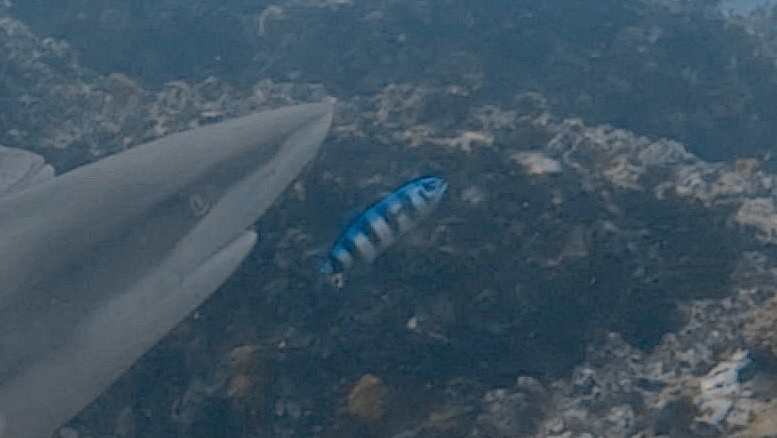
The Pilot (Naucrates ductor) is a saltwater fish of the family Carangidae that grows up to 70 cm.
Description
The pilotfish is a streamlined oceanic fish of the family Carangidae reaching about 70 cm. The body is bluish with six to seven broad dark cross-bars and white tips on the tail and fin lobes. The species is known for its remarkable behaviour: it travels in a semi-obligate commensal relationship with sharks, rays, large fish and sea turtles, feeding on their food scraps, parasites and excrement, supplemented with small fish and invertebrates. The pilotfish occurs circumtropically in all oceans, often far from the coast. Juveniles shelter among jellyfish and drifting seaweed until large enough to associate with bigger hosts.
Frequently asked questions
How do you recognise the Pilot?
The Pilot has a torpedo-shaped body, is mainly blue and shows a vertical stripes pattern.
Where does the Pilot live?
The Pilot lives in the sea (marine waters) and is mostly found around stony or rocky ground.
How big does the Pilot get?
The Pilot grows to a maximum of about 70 cm. On average the species is around 40 cm.
Is the Pilot dangerous to humans?
No, the Pilot is harmless to humans.
Is the Pilot edible?
The Pilot is rarely eaten.
Download Fin's Fish Guide
Identify fish in seconds, log your catches and dives. Join the TestFlight beta.
All data
Identification
Appearance
Habitat & distribution
Behaviour & biology
For anglers
Safety
Status & sources
More from the family Carangidae

Download Fin's Fish Guide
Identify fish in seconds, log your catches and dives. Join the TestFlight beta.