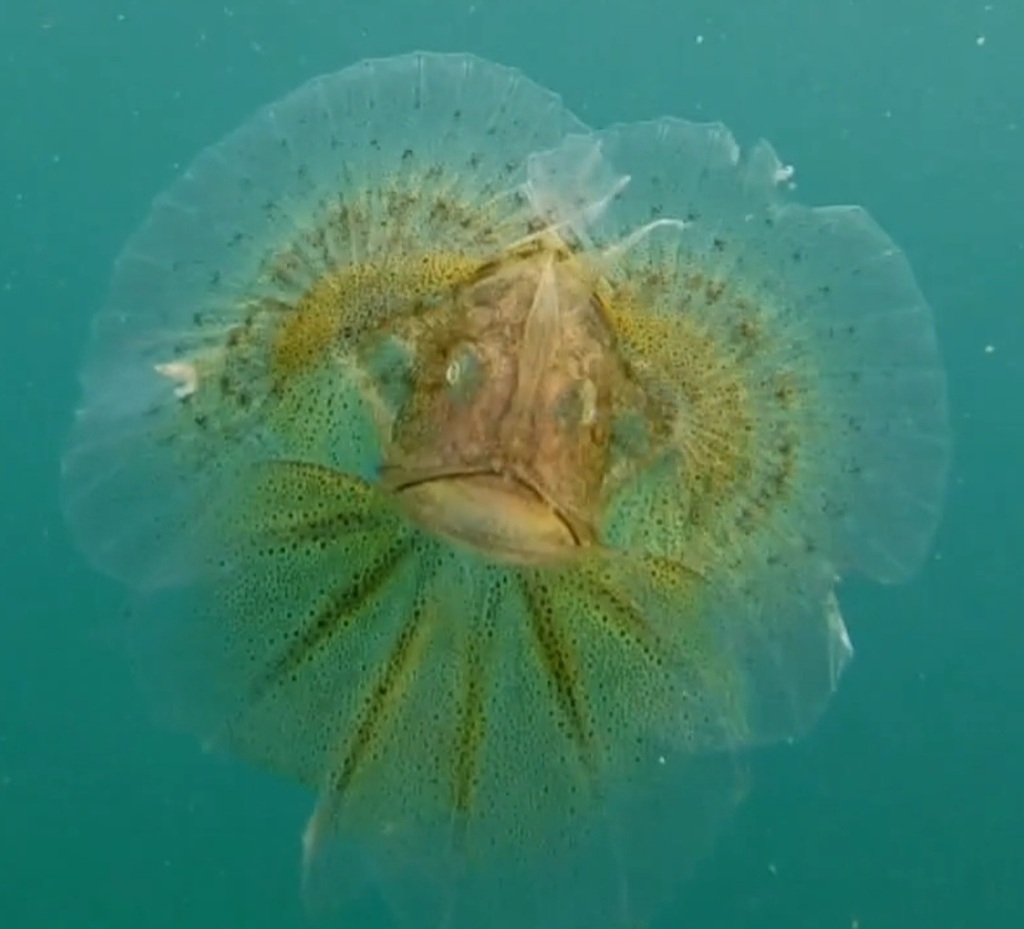
The American angler (Lophius americanus) is a saltwater fish of the family Lophiidae that grows up to 120 cm.
Description
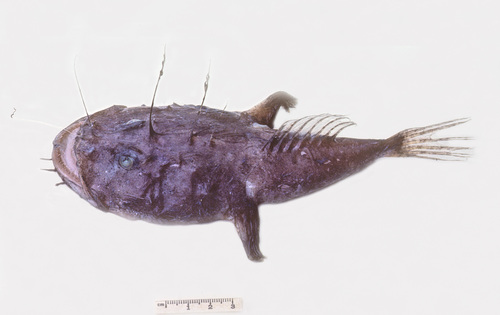
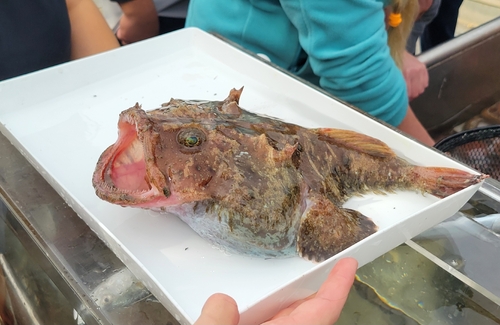
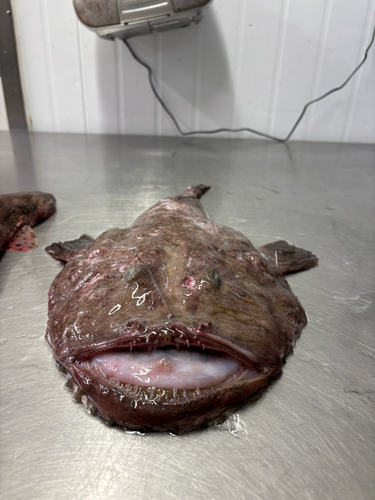
The American angler (goosefish) is a huge, flattened anglerfish of the family Lophiidae reaching about 1.2 metres. Almost half the fish is a broad, flat head with an enormous, upturned mouth full of inward-curved needle teeth. The first dorsal ray is modified into a movable rod with a lure (illicium), with which the fish draws prey just in front of the mouth and then engulfs it in a flash. The species lives buried on soft bottoms of the continental shelf and slope along the east coast of North America. It eats mainly fish, including other bottom fish, plus squid. The eggs are released in a metres-long, floating gelatinous veil. The tail yields the prized 'monkfish' flesh.
Frequently asked questions
How do you recognise the American angler?
The American angler has a flattened, disc-shaped body, is mainly brown and shows a marbled pattern.
Where does the American angler live?
The American angler lives in the sea (marine waters) and is mostly found around sand or mud bottom.
How big does the American angler get?
The American angler grows to a maximum of about 120 cm. On average the species is around 90 cm.
Is the American angler dangerous to humans?
The American angler can bite, but is otherwise not dangerous to humans.
Is the American angler edible?
Yes, the American angler is a highly prized food fish.
Download Fin's Fish Guide
Identify fish in seconds, log your catches and dives. Join the TestFlight beta.
All data
Identification
Appearance
Habitat & distribution
Behaviour & biology
For anglers
Safety
Status & sources
Same genus Lophius
More from the family Lophiidae


Download Fin's Fish Guide
Identify fish in seconds, log your catches and dives. Join the TestFlight beta.