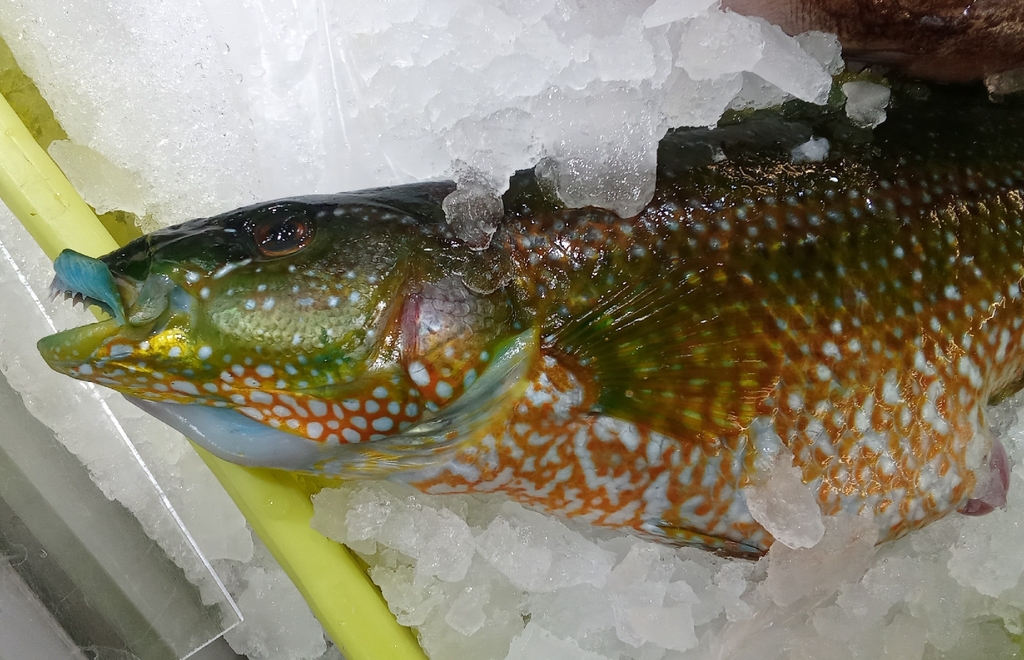
The Green wrasse (Labrus viridis) is a saltwater fish of the family Labridae that grows up to 47 cm.
Description
The green wrasse is a robust wrasse of the family Labridae reaching about 47 cm. The elongate body has the thick lips typical of wrasses and a highly variable colour, often greenish or brownish with a pale lengthwise stripe along the flank. Like many wrasses the species is a protogynous hermaphrodite: individuals begin as females and may later turn into males. It lives in seagrass beds and on rocky bottoms of shallow coastal water of the Mediterranean and the adjacent eastern Atlantic. With strong throat teeth it crushes molluscs, crustaceans and sea urchins. In spring the male builds a nest of weed. Through overfishing and habitat loss the species is assessed as Vulnerable (VU).
Frequently asked questions
How do you recognise the Green wrasse?
The Green wrasse has a torpedo-shaped body, is mainly green and shows a plain pattern.
Where does the Green wrasse live?
The Green wrasse lives in the sea (marine waters) and is mostly found around algae or seagrass beds.
How big does the Green wrasse get?
The Green wrasse grows to a maximum of about 47 cm. On average the species is around 38 cm.
Is the Green wrasse dangerous to humans?
No, the Green wrasse is harmless to humans.
Is the Green wrasse edible?
Yes, the Green wrasse is commonly eaten.
Download Fin's Fish Guide
Identify fish in seconds, log your catches and dives. Join the TestFlight beta.
All data
Identification
Appearance
Habitat & distribution
Behaviour & biology
For anglers
Safety
Status & sources
Same genus Labrus
More from the family Labridae
Download Fin's Fish Guide
Identify fish in seconds, log your catches and dives. Join the TestFlight beta.