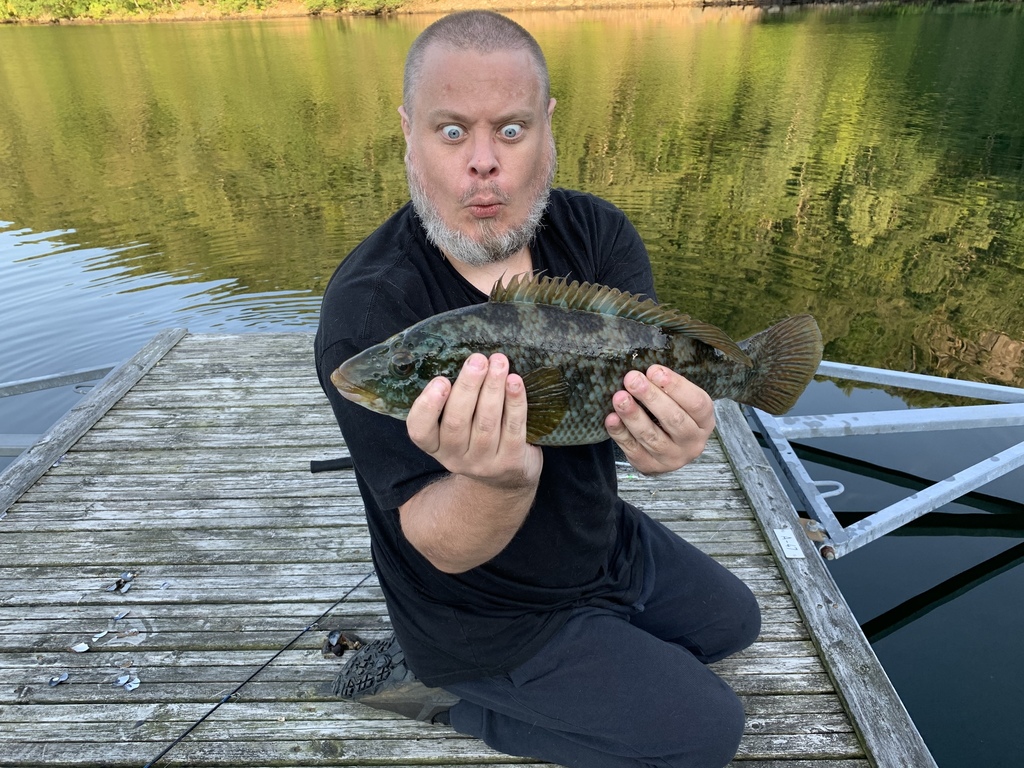
The Ballan wrasse (Labrus bergylta) is a saltwater fish of the family Labridae that grows up to 66 cm.
Description
The ballan wrasse is the largest wrasse of north-western Europe; this species of the family Labridae reaches about 65 cm. The sturdy body has thick, fleshy lips and strong jaw teeth, and the colour is highly variable: brown-green to red-brown, usually with a fine net pattern of pale spots. The species lives on rocky, weedy shores of the north-eastern Atlantic, from shallow water to a few tens of metres. With its powerful jaws it crushes shellfish, crabs, sea urchins and snails. Like many wrasses it is a protogynous hermaphrodite: females can change into males. The male builds a nest of weeds and guards the eggs. It is used, among other things, as a 'cleaner fish' against sea lice in salmon farms.
Frequently asked questions
How do you recognise the Ballan wrasse?
The Ballan wrasse has a torpedo-shaped body, is mainly brown and shows a spots pattern.
Where does the Ballan wrasse live?
The Ballan wrasse lives in the sea (marine waters) and is mostly found around stony or rocky ground.
How big does the Ballan wrasse get?
The Ballan wrasse grows to a maximum of about 66 cm. On average the species is around 50 cm.
Is the Ballan wrasse dangerous to humans?
No, the Ballan wrasse is harmless to humans.
Is the Ballan wrasse edible?
The Ballan wrasse is rarely eaten.
Download Fin's Fish Guide
Identify fish in seconds, log your catches and dives. Join the TestFlight beta.
All data
Identification
Appearance
Habitat & distribution
Behaviour & biology
For anglers
Safety
Status & sources
Same genus Labrus
More from the family Labridae
Download Fin's Fish Guide
Identify fish in seconds, log your catches and dives. Join the TestFlight beta.