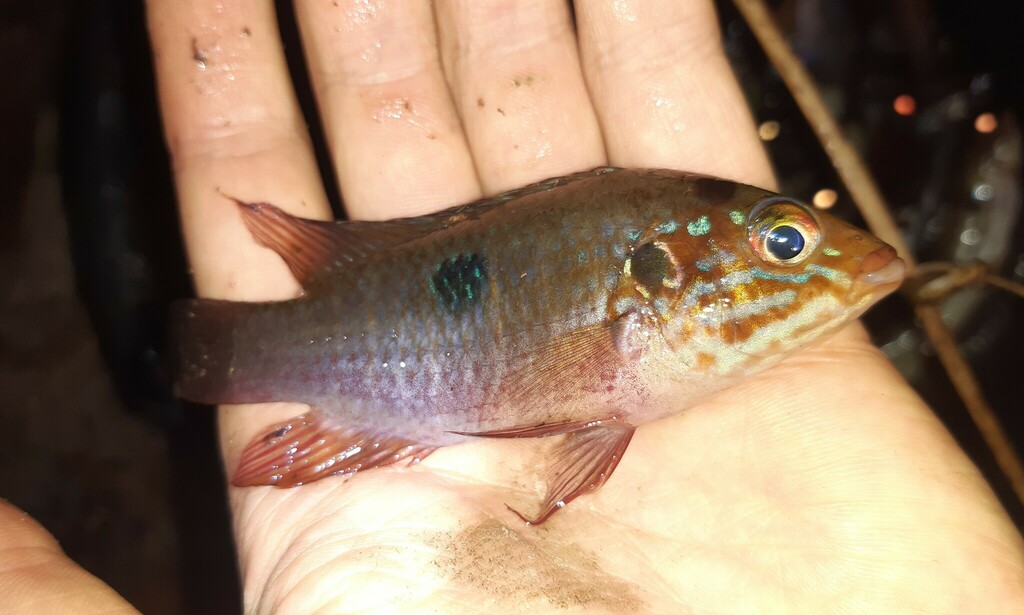
The Cherry-belly jewelfish (Hemichromis cerasogaster) is a freshwater fish of the family Cichlidae that grows up to 9 cm.
Description
The cherry-belly jewelfish is a jewel cichlid endemic to Lake Mai-Ndombe (formerly Lake Leopold II) in the Democratic Republic of the Congo. It grows to about 9 cm and turns bright cherry-red on the belly especially during courtship and brood care, from which it takes its name. It lives in shore and open water of the lake and feeds on small animals. It is probably a substrate spawner with a strong pair bond and biparental care. Because of its limited range the species is listed as Endangered (EN) on the IUCN Red List.
Frequently asked questions
How do you recognise the Cherry-belly jewelfish?
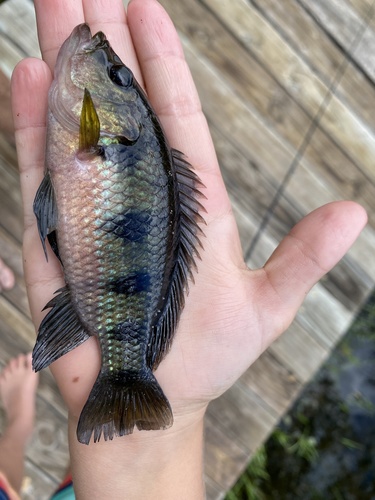
The Cherry-belly jewelfish has a torpedo-shaped body, is mainly red-orange and shows a spots pattern.
Where does the Cherry-belly jewelfish live?
The Cherry-belly jewelfish lives in fresh water and is mostly found around mixed bottom.
How big does the Cherry-belly jewelfish get?
The Cherry-belly jewelfish grows to a maximum of about 9 cm.
Is the Cherry-belly jewelfish dangerous to humans?
No, the Cherry-belly jewelfish is harmless to humans.
Is the Cherry-belly jewelfish edible?
The Cherry-belly jewelfish is rarely eaten.
Download Fin's Fish Guide
Identify fish in seconds, log your catches and dives. Join the TestFlight beta.
All data
Identification
Appearance
Habitat & distribution
Behaviour & biology
Safety
Status & sources
Same genus Hemichromis


More from the family Cichlidae



Download Fin's Fish Guide
Identify fish in seconds, log your catches and dives. Join the TestFlight beta.