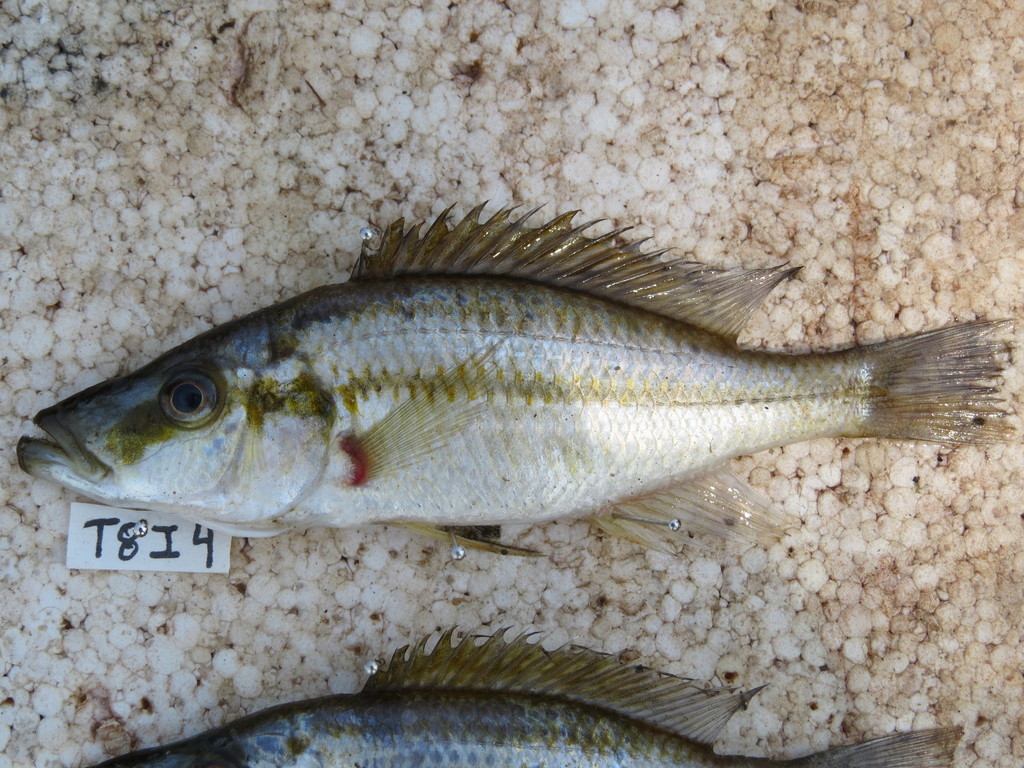
The Eyebiter (Dimidiochromis compressiceps) is a freshwater fish of the family Cichlidae that grows up to 23 cm.
Description
The Malawi eyebiter is a large predatory cichlid endemic to Lake Malawi in East Africa. The species grows to about 25 cm and has a strongly laterally compressed, knife-shaped body with a pointed head, adapted to stalking among water plants. It lives in vegetated, shallow zones. As an ambush hunter it often hangs obliquely among the plant growth and springs on small fishes, especially juvenile utaka and other shoaling fishes. The common name 'eyebiter' refers to a disputed story about biting out eyes; in reality it eats whole prey fishes. It is a maternal mouthbrooder. The species is harmless to humans.
Frequently asked questions
How do you recognise the Eyebiter?
The Eyebiter has a torpedo-shaped body, is mainly silver-grey and shows a plain pattern.
Where does the Eyebiter live?
The Eyebiter lives in fresh water and is mostly found around mixed bottom.
How big does the Eyebiter get?
The Eyebiter grows to a maximum of about 23 cm.
Is the Eyebiter dangerous to humans?
No, the Eyebiter is harmless to humans.
Is the Eyebiter edible?
The Eyebiter is rarely eaten.
Download Fin's Fish Guide
Identify fish in seconds, log your catches and dives. Join the TestFlight beta.
All data
Identification
Appearance
Habitat & distribution
Behaviour & biology
For anglers
Safety
Status & sources
Same genus Dimidiochromis

More from the family Cichlidae



Download Fin's Fish Guide
Identify fish in seconds, log your catches and dives. Join the TestFlight beta.