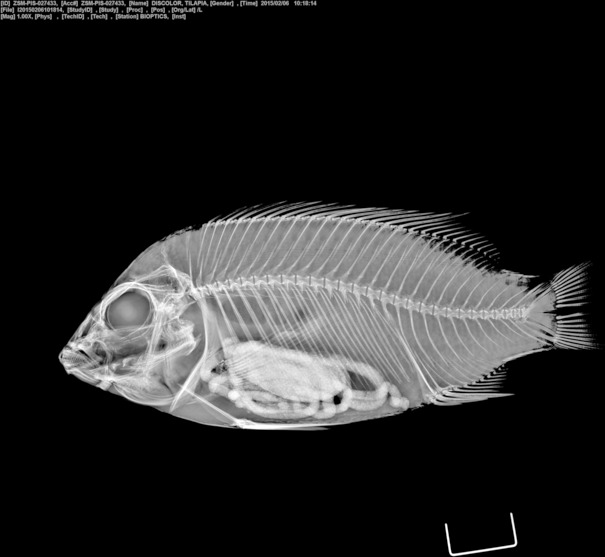
The Discolor tilapia (Coptodon discolor) is a freshwater fish of the family Cichlidae that grows up to 23 cm.
Description
The discolor tilapia is a cichlid from West Africa, occurring in the Bia, Tano and Pra rivers in Côte d'Ivoire and Ghana and in Lake Bosumtwi in Ghana. It grows to about 22 cm and has whitish flanks and belly with irregular black spots on the head, back and flanks and a strongly convex head profile. It feeds mainly on plant matter, supplemented with small crustaceans and insects. The fish is a substrate brooder: a pair cleans a nest together and both parents guard the brood. Because of its limited range the species is listed as Near Threatened (NT) on the IUCN Red List.
Frequently asked questions
How do you recognise the Discolor tilapia?
The Discolor tilapia has a torpedo-shaped body, is mainly white and shows a spots pattern.
Where does the Discolor tilapia live?
The Discolor tilapia lives in fresh water and is mostly found around sand or mud bottom.
How big does the Discolor tilapia get?
The Discolor tilapia grows to a maximum of about 23 cm.
Is the Discolor tilapia dangerous to humans?
No, the Discolor tilapia is harmless to humans.
Is the Discolor tilapia edible?
Yes, the Discolor tilapia is commonly eaten.
Download Fin's Fish Guide
Identify fish in seconds, log your catches and dives. Join the TestFlight beta.
All data
Identification
Appearance
Habitat & distribution
Behaviour & biology
For anglers
Safety
Status & sources
Same genus Coptodon


More from the family Cichlidae



Download Fin's Fish Guide
Identify fish in seconds, log your catches and dives. Join the TestFlight beta.