
The Macedonian barbel (Barbus macedonicus) is a freshwater fish of the family Cyprinidae that grows up to 65 cm.
Description
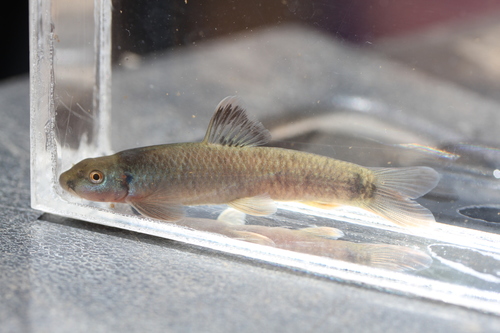
The macedonian barbel is an elongate cyprinid of the family Cyprinidae reaching about 65 cm. The yellow-brown body is often covered with dark speckles; the inferior mouth carries four barbels and thick lips, with which the fish probes the bottom. The species is adapted to cool, flowing water and lives on gravel and stone bottoms of the upper and middle reaches of rivers. At up to 65 cm this is one of the larger southern barbels. As an omnivore it seeks insect larvae, small crustaceans, worms and some plant material. In late spring and summer it spawns upstream on gravel. Like other barbels the roe and its membrane are mildly toxic in the spawning season and can cause stomach upset; the flesh itself is safe.
Frequently asked questions
How do you recognise the Macedonian barbel?
The Macedonian barbel has an elongate, eel-like body, is mainly brown and shows a spots pattern.
Where does the Macedonian barbel live?
The Macedonian barbel lives in fresh water and is mostly found around mixed bottom.
How big does the Macedonian barbel get?
The Macedonian barbel grows to a maximum of about 65 cm.
Is the Macedonian barbel dangerous to humans?
No, the Macedonian barbel is harmless to humans.
Is the Macedonian barbel edible?
The Macedonian barbel is rarely eaten.
Download Fin's Fish Guide
Identify fish in seconds, log your catches and dives. Join the TestFlight beta.
All data
Identification
Appearance
Habitat & distribution
Behaviour & biology
For anglers
Safety
Status & sources
Same genus Barbus
More from the family Cyprinidae


Download Fin's Fish Guide
Identify fish in seconds, log your catches and dives. Join the TestFlight beta.