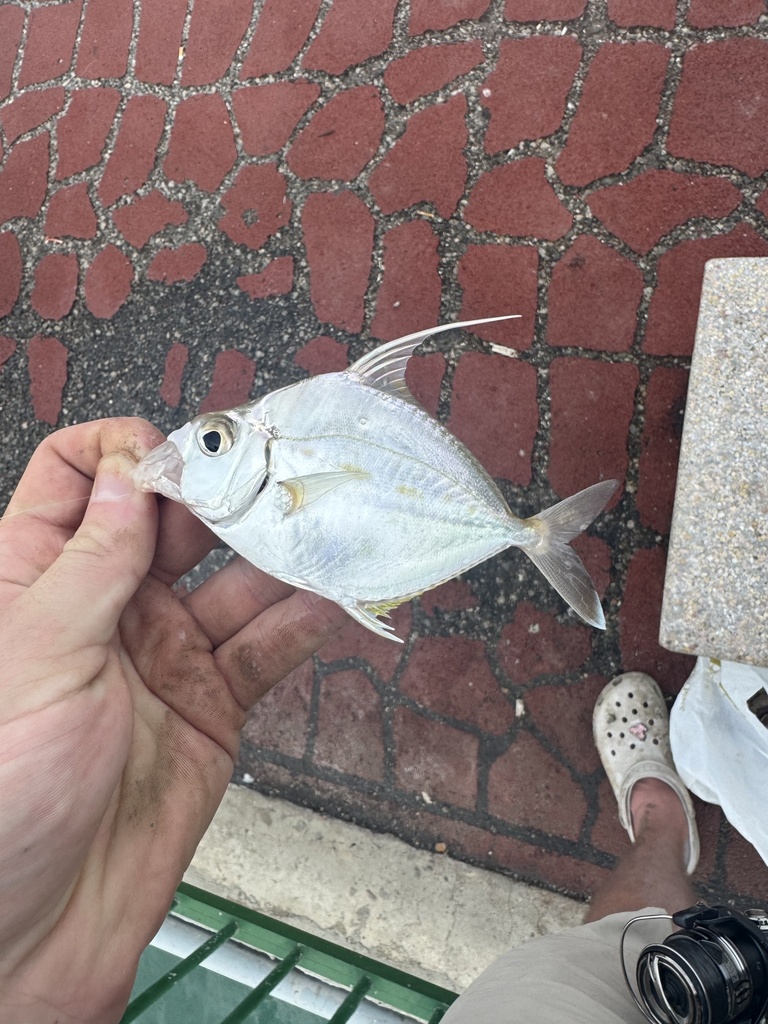
The Banded ponyfish (Aurigequula fasciata) is a brackish-water fish of the family Leiognathidae that grows up to 21 cm.
Description
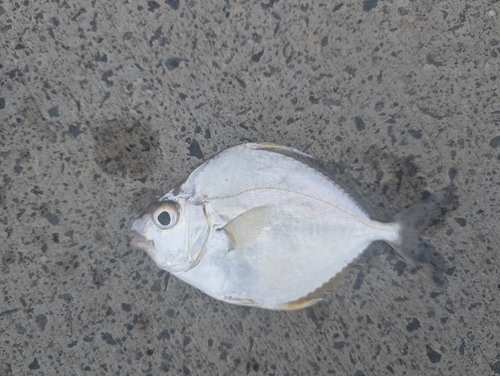
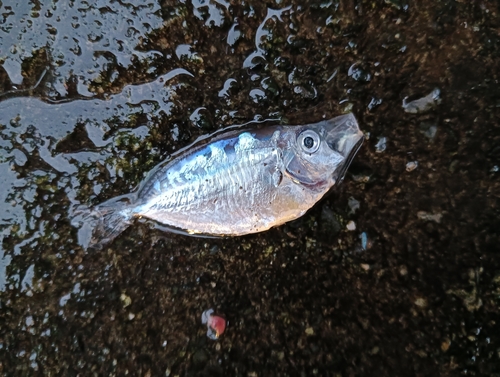
The striped ponyfish is a fish of the ponyfish family (Leiognathidae) from the Indo-West Pacific. The species grows to about 21 cm and has a deep, strongly laterally compressed, silvery body with fine crossbars and a highly protrusible, tube-like mouth. It occurs in coastal waters and also enters semi-enclosed seas and estuaries. As a bottom searcher it sucks up small invertebrates, worms and plankton with its protrusible mouth. Ponyfishes have a light organ with luminous bacteria around the gullet, with which they give light signals in schools. The species is a local food fish and is harmless to humans.
Frequently asked questions
How do you recognise the Banded ponyfish?
The Banded ponyfish has a flattened, disc-shaped body, is mainly silver-grey and shows a vertical stripes pattern.
Where does the Banded ponyfish live?
The Banded ponyfish lives in brackish water and is mostly found around sand or mud bottom.
How big does the Banded ponyfish get?
The Banded ponyfish grows to a maximum of about 21 cm. On average the species is around 17 cm.
Is the Banded ponyfish dangerous to humans?
No, the Banded ponyfish is harmless to humans.
Is the Banded ponyfish edible?
Yes, the Banded ponyfish is commonly eaten.
Download Fin's Fish Guide
Identify fish in seconds, log your catches and dives. Join the TestFlight beta.
All data
Identification
Appearance
Habitat & distribution
Behaviour & biology
For anglers
Safety
Status & sources
More from the family Leiognathidae


Download Fin's Fish Guide
Identify fish in seconds, log your catches and dives. Join the TestFlight beta.