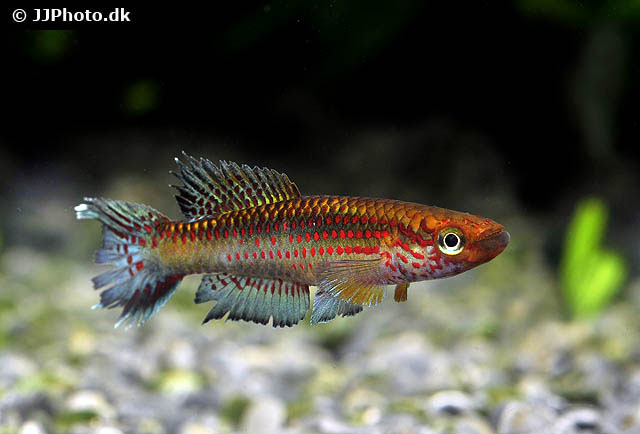
The Riggenbach's killifish (Aphyosemion riggenbachi) is a freshwater fish of the family Nothobranchiidae that grows up to 7 cm.
Description
The Riggenbach's killifish is a killifish (Nothobranchiidae) from small forest streams, pools and swamps of Cameroon in West-Central Africa. The species grows to about 5 cm; males are brightly coloured with red, blue and yellow spots and coloured fin margins, females stay an inconspicuous brown. As a fish of shallow, often shaded and oxygen-poor water it snaps at insect larvae, small crustaceans and worms; many species lay their eggs among leaf litter. The fish is harmless to humans.
Frequently asked questions
How do you recognise the Riggenbach's killifish?
The Riggenbach's killifish has a torpedo-shaped body, is mainly multicoloured and shows a spots pattern.
Where does the Riggenbach's killifish live?
The Riggenbach's killifish lives in fresh water and is mostly found around open water.
How big does the Riggenbach's killifish get?
The Riggenbach's killifish grows to a maximum of about 7 cm.
Is the Riggenbach's killifish dangerous to humans?
No, the Riggenbach's killifish is harmless to humans.
Is the Riggenbach's killifish edible?
The Riggenbach's killifish is not usually eaten.
Download Fin's Fish Guide
Identify fish in seconds, log your catches and dives. Join the TestFlight beta.
All data
Identification
Appearance
Habitat & distribution
Behaviour & biology
For anglers
Safety
Status & sources
Same genus Aphyosemion


More from the family Nothobranchiidae
Download Fin's Fish Guide
Identify fish in seconds, log your catches and dives. Join the TestFlight beta.