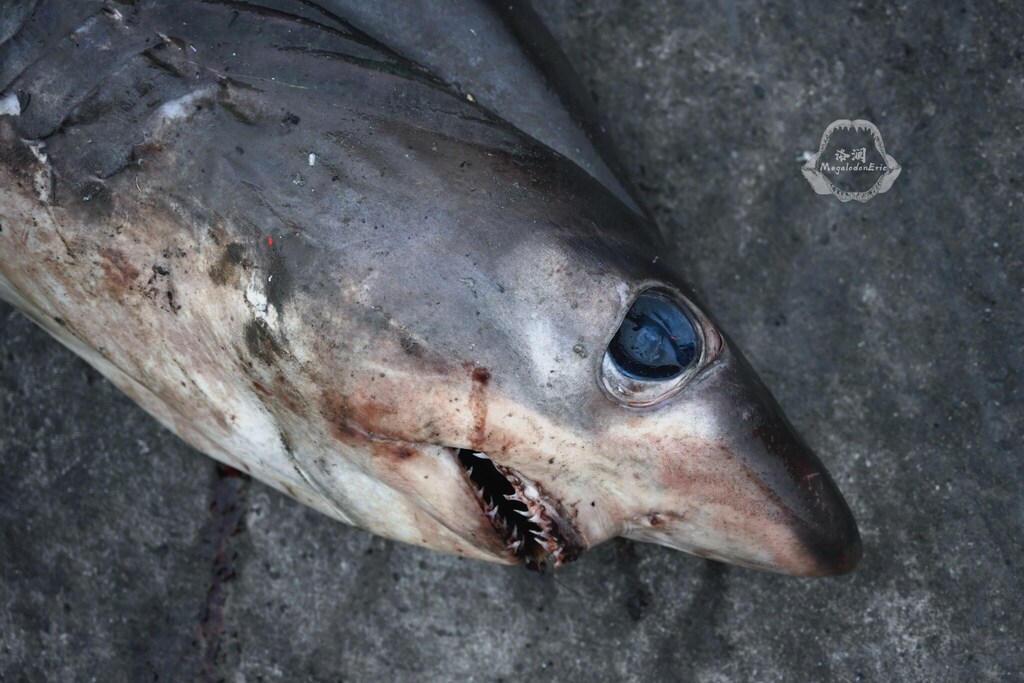
The Bigeye thresher (Alopias superciliosus) is a saltwater fish of the family Alopiidae that grows up to 488 cm.
Description
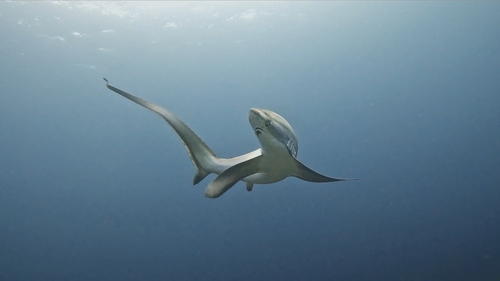
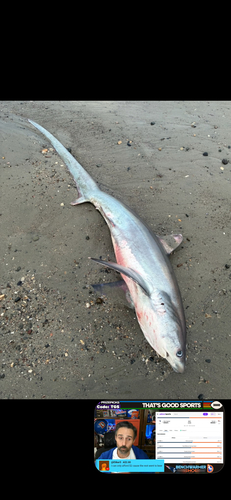
The bigeye thresher is a large shark of the family Alopiidae (thresher sharks) reaching about 4.9 metres including the tail. Characteristic are the huge, upward-directed eyes, an adaptation to the gloom of the depths, and the whip-like upper tail lobe that is nearly as long as the rest of the body. With it the shark slaps into a fish school to herd and stun prey, which it then swallows. The species lives pelagically in deep, warm water worldwide and often stays at greater depth by day. It is viviparous, with very small litters because the embryos eat unfertilised eggs in the uterus. Through fishing and bycatch it is assessed as Vulnerable (VU).
Frequently asked questions
How do you recognise the Bigeye thresher?
The Bigeye thresher has a torpedo-shaped body, is mainly silver-grey and shows a plain pattern.
Where does the Bigeye thresher live?
The Bigeye thresher lives in the sea (marine waters) and is mostly found around open water.
How big does the Bigeye thresher get?
The Bigeye thresher grows to a maximum of about 488 cm. On average the species is around 350 cm.
Is the Bigeye thresher dangerous to humans?
The Bigeye thresher can bite, but is otherwise not dangerous to humans.
Is the Bigeye thresher edible?
The Bigeye thresher is rarely eaten.
Download Fin's Fish Guide
Identify fish in seconds, log your catches and dives. Join the TestFlight beta.
All data
Identification
Appearance
Habitat & distribution
Behaviour & biology
For anglers
Safety
Status & sources
Same genus Alopias
More from the family Alopiidae
Download Fin's Fish Guide
Identify fish in seconds, log your catches and dives. Join the TestFlight beta.