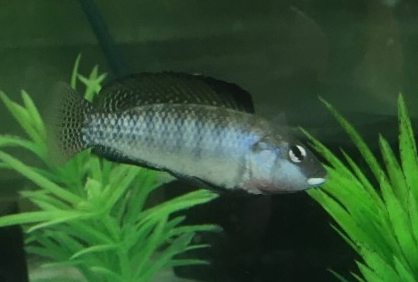
The Lake Magadi tilapia (Alcolapia grahami) is a freshwater fish of the family Cichlidae that grows up to 11 cm.
Description
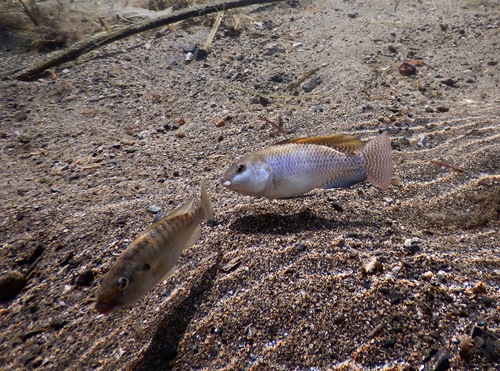
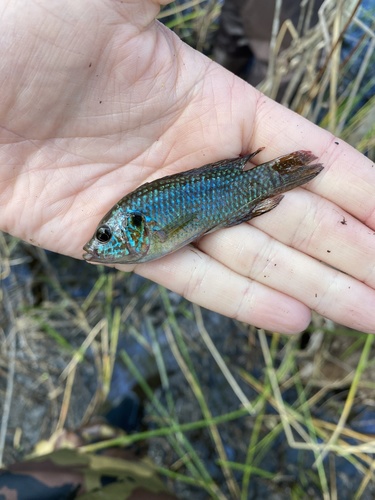
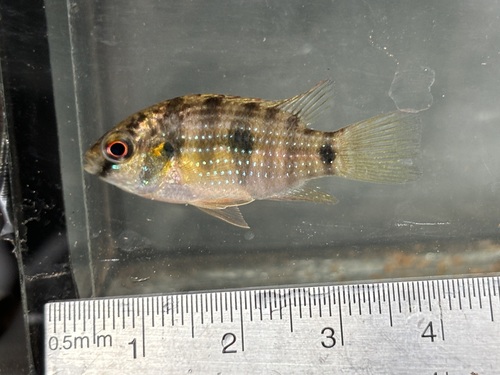
The Lake Magadi tilapia is a small cichlid native only to Lake Magadi in Kenya, an extremely alkaline soda lake, and introduced to lakes such as Nakuru and Natron. The species grows to only about 11 cm. Females are golden, while males have pale blue flanks, white mouth patches and iridescent blue speckles. The fish is exceptionally well adapted to hostile conditions: it tolerates water above 40 degrees, excretes urea, and gulps air at high temperatures. It grazes on cyanobacteria and eats small invertebrates. Females are mouthbrooders. Because of its very small range the species is regarded as Vulnerable (VU).
Frequently asked questions
How do you recognise the Lake Magadi tilapia?
The Lake Magadi tilapia has a torpedo-shaped body, is mainly yellow-gold and shows a plain pattern.
Where does the Lake Magadi tilapia live?
The Lake Magadi tilapia lives in fresh water and is mostly found around mixed bottom.
How big does the Lake Magadi tilapia get?
The Lake Magadi tilapia grows to a maximum of about 11 cm.
Is the Lake Magadi tilapia dangerous to humans?
No, the Lake Magadi tilapia is harmless to humans.
Is the Lake Magadi tilapia edible?
The Lake Magadi tilapia is rarely eaten.
Download Fin's Fish Guide
Identify fish in seconds, log your catches and dives. Join the TestFlight beta.
All data
Identification
Appearance
Habitat & distribution
Behaviour & biology
For anglers
Safety
Status & sources
Same genus Alcolapia
More from the family Cichlidae



Download Fin's Fish Guide
Identify fish in seconds, log your catches and dives. Join the TestFlight beta.