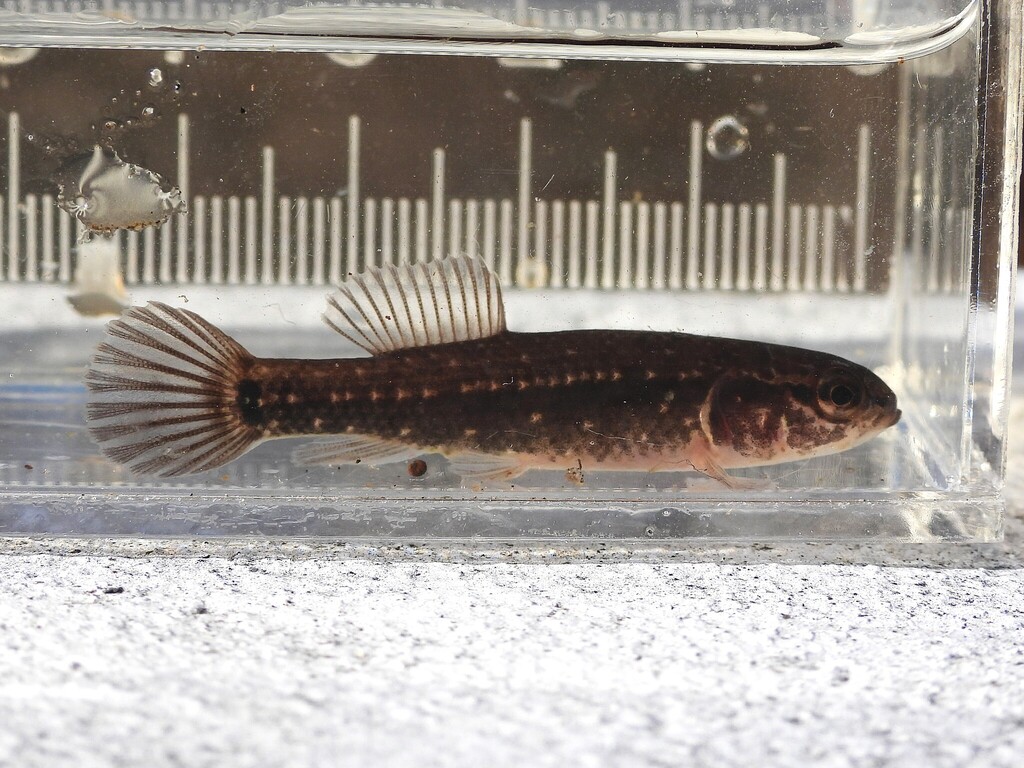
The Eastern mudminnow (Umbra pygmaea) is a freshwater fish of the family Umbridae that grows up to 14 cm.
Description
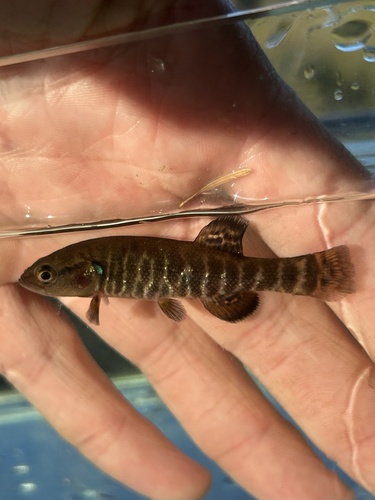
The eastern mudminnow is a small, hardy freshwater fish of the family Umbridae reaching about 14 cm. The stout, brownish body bears several narrow, dark longitudinal stripes and a rounded tail. The species is native to the eastern United States but has been introduced to Europe and locally established, including in Dutch and Belgian moorland pools, ditches and marshes. It is extraordinarily tolerant of oxygen-poor, warm and acidic water and can gulp air with its swim bladder to survive. It hunts small aquatic insects, crustaceans and worms. In spring the female guards the eggs in a nest among water plants. Through its hardiness it can displace native species.
Frequently asked questions
How do you recognise the Eastern mudminnow?
The Eastern mudminnow has a torpedo-shaped body, is mainly brown and shows a horizontal stripes pattern.
Where does the Eastern mudminnow live?
The Eastern mudminnow lives in fresh water and is mostly found around sand or mud bottom.
How big does the Eastern mudminnow get?
The Eastern mudminnow grows to a maximum of about 14 cm.
Is the Eastern mudminnow dangerous to humans?
No, the Eastern mudminnow is harmless to humans.
Is the Eastern mudminnow edible?
The Eastern mudminnow is not usually eaten.
Download Fin's Fish Guide
Identify fish in seconds, log your catches and dives. Join the TestFlight beta.
All data
Identification
Appearance
Habitat & distribution
Behaviour & biology
For anglers
Safety
Status & sources
Same genus Umbra
More from the family Umbridae
Download Fin's Fish Guide
Identify fish in seconds, log your catches and dives. Join the TestFlight beta.