
The Big-scaled redfin (Tribolodon hakonensis) is a fish that lives in both fresh and salt water of the family Cyprinidae that grows up to 45 cm.
Description
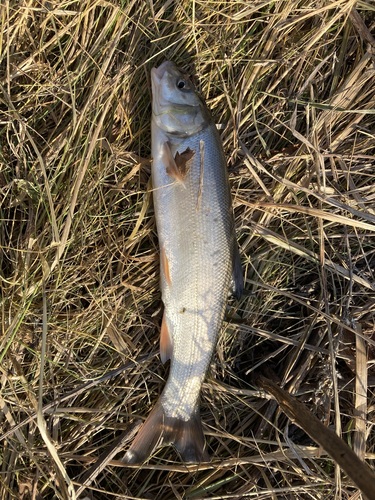
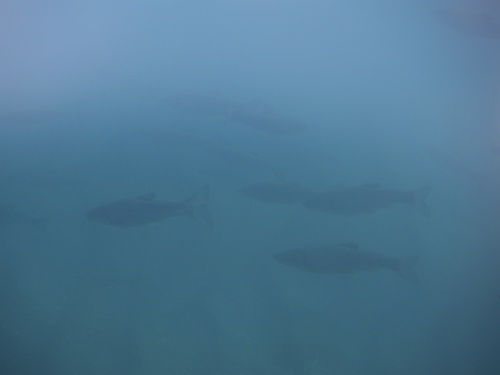
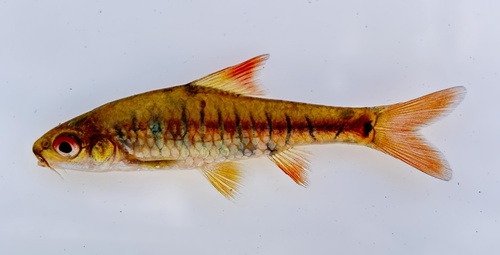
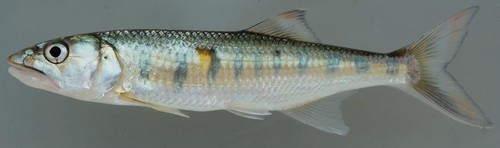
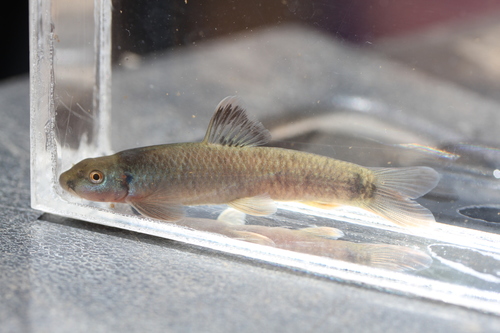
The big-scaled redfin is a robust cyprinid of the family Leuciscidae reaching about 45 cm and exceptional because, unlike almost all other cyprinids, it can live in the sea and tolerates the saltwater transition. The silvery-grey body develops several orange-red lengthwise stripes along the flank in the breeding season. The species comes from East Asia and lives in rivers and coastal water; many populations are anadromous and run up the river in spring to spawn on gravel bars. As an omnivore it eats insects, crustaceans, worms, algae and small fish. It is a common and valued sport and food fish in Japan.
Frequently asked questions
How do you recognise the Big-scaled redfin?
The Big-scaled redfin is mainly silver-grey and shows a horizontal stripes pattern.
Where does the Big-scaled redfin live?
The Big-scaled redfin lives in both fresh and salt water and is mostly found around stony or rocky ground.
How big does the Big-scaled redfin get?
The Big-scaled redfin grows to a maximum of about 45 cm.
Is the Big-scaled redfin dangerous to humans?
No, the Big-scaled redfin is harmless to humans.
Is the Big-scaled redfin edible?
Yes, the Big-scaled redfin is commonly eaten.
Download Fin's Fish Guide
Identify fish in seconds, log your catches and dives. Join the TestFlight beta.
All data
Identification
Appearance
Habitat & distribution
Behaviour & biology
For anglers
Safety
Status & sources
Same genus Tribolodon
More from the family Cyprinidae


Download Fin's Fish Guide
Identify fish in seconds, log your catches and dives. Join the TestFlight beta.