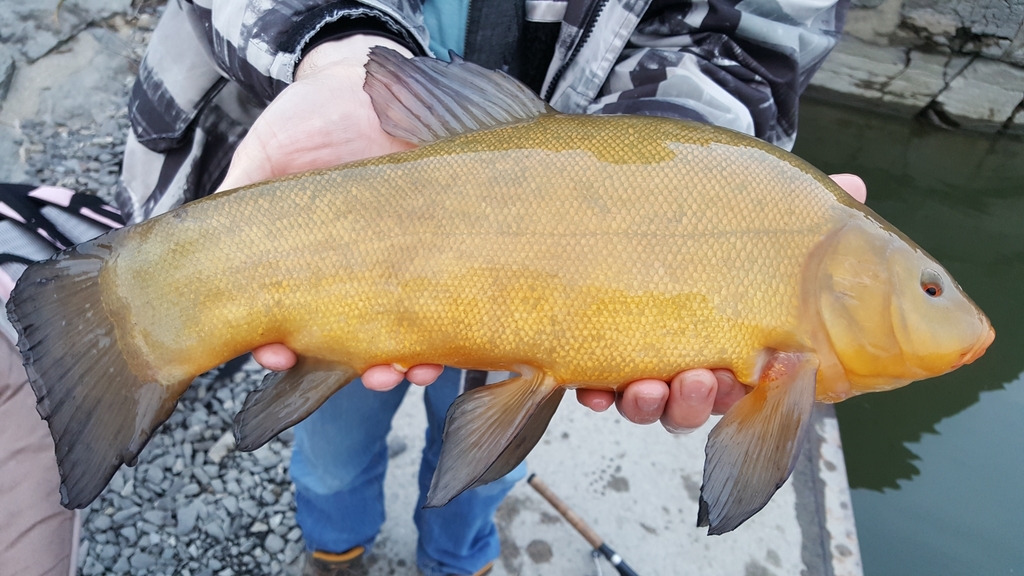
The Tench (Tinca tinca) is a freshwater fish of the family Cyprinidae that grows up to 70 cm.
Description
The tench is a sturdy, dark-green cyprinid of the family Cyprinidae reaching about 70 cm. The stout body has very small scales, a thick layer of slime, strikingly small red eyes, rounded fins and a single short barbel at each corner of the mouth. The species likes warm, vegetation-rich, still or slow-flowing fresh water such as ponds, lakes and ditches, and tolerates low-oxygen conditions well. On the bottom it roots for midge larvae, snails, worms and plant matter. In the warm summer it spawns late; in winter it is barely active and partly buries itself in the mud. The tench is a popular and strong fish for angling.
Frequently asked questions
How do you recognise the Tench?
The Tench has a torpedo-shaped body, is mainly green and shows a plain pattern.
Where does the Tench live?
The Tench lives in fresh water and is mostly found around sand or mud bottom.
How big does the Tench get?
The Tench grows to a maximum of about 70 cm. On average the species is around 20 cm.
Is the Tench dangerous to humans?
No, the Tench is harmless to humans.
Is the Tench edible?
The Tench is rarely eaten.
Download Fin's Fish Guide
Identify fish in seconds, log your catches and dives. Join the TestFlight beta.
All data
Identification
Appearance
Habitat & distribution
Behaviour & biology
For anglers
Safety
Status & sources
More from the family Cyprinidae


Download Fin's Fish Guide
Identify fish in seconds, log your catches and dives. Join the TestFlight beta.