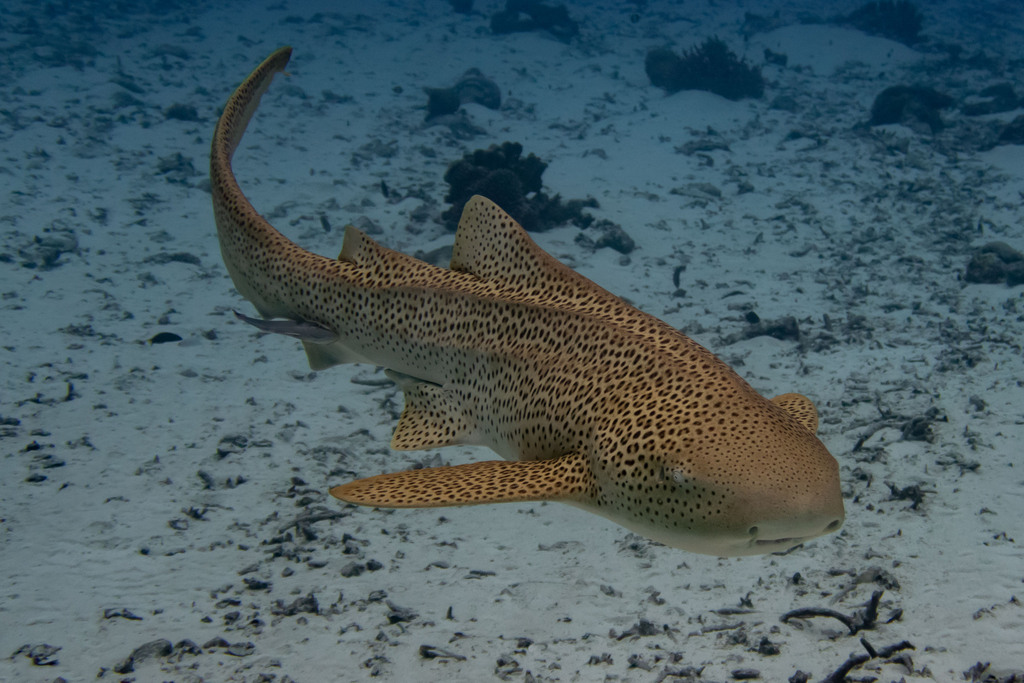
The Zebra shark (Stegostoma fasciatum) is a fish of the family Stegostomatidae that grows up to 250 cm.
Description
The zebra shark is a large, slow bottom shark and the only species of the family Stegostomatidae from the Indo-Pacific. The species can grow to about 2.5 metres and has an elongate body with lengthwise ridges and a very long tail; juveniles are dark with pale stripes (hence 'zebra'), while adults are pale with dark spots (a leopard pattern). It lives on sand and coral bottoms of reefs, where by day it rests and at night searches crevices for molluscs, crustaceans and small fishes. It is completely harmless to humans, but is heavily pressured by fishing.
Frequently asked questions
How do you recognise the Zebra shark?
The Zebra shark is mainly yellow-gold and shows a spots pattern.
Where does the Zebra shark live?
The Zebra shark is mostly found around stony or rocky ground.
How big does the Zebra shark get?
The Zebra shark grows to a maximum of about 250 cm.
Is the Zebra shark dangerous to humans?
No, the Zebra shark is harmless to humans.
Is the Zebra shark edible?
Yes, the Zebra shark is commonly eaten.
Download Fin's Fish Guide
Identify fish in seconds, log your catches and dives. Join the TestFlight beta.
All data
Identification
Appearance
Habitat & distribution
Behaviour & biology
For anglers
Safety
Status & sources
Download Fin's Fish Guide
Identify fish in seconds, log your catches and dives. Join the TestFlight beta.