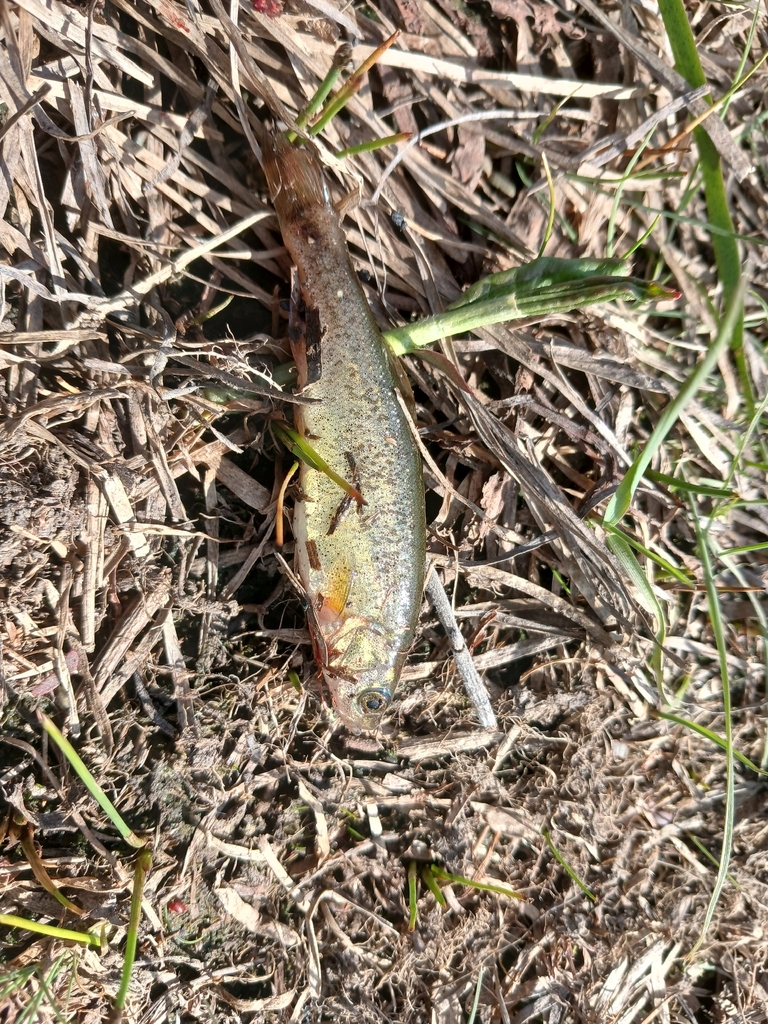
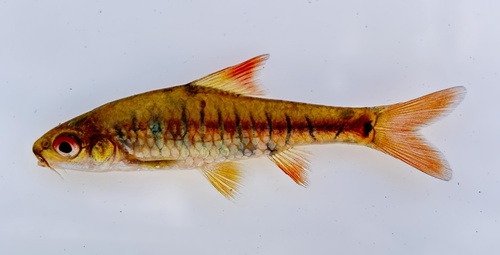
The Lake minnow (Rhynchocypris percnurus) is a freshwater fish of the family Cyprinidae that grows up to 12 cm.
Description
The lake minnow is a small cyprinid with a wide range extending from Central Europe through Siberia to East Asia. The species reaches about 12 cm and has a stocky, brown-gold body with a mottled pattern. It inhabits densely vegetated, often oxygen-poor swamps, bog pools, ditches and small ponds, where it lives in schools. As an omnivore the fish feeds on zooplankton, insect larvae, algae and plant matter. In parts of Western Europe the species has become rare through loss of marsh habitat and is locally legally protected, although globally it is considered not threatened.
Frequently asked questions
How do you recognise the Lake minnow?
The Lake minnow has a torpedo-shaped body, is mainly brown and shows a spots pattern.
Where does the Lake minnow live?
The Lake minnow lives in fresh water and is mostly found around mixed bottom.
How big does the Lake minnow get?
The Lake minnow grows to a maximum of about 12 cm. On average the species is around 8 cm.
Is the Lake minnow dangerous to humans?
No, the Lake minnow is harmless to humans.
Is the Lake minnow edible?
The Lake minnow is not usually eaten.
Download Fin's Fish Guide
Identify fish in seconds, log your catches and dives. Join the TestFlight beta.
All data
Identification
Appearance
Habitat & distribution
Behaviour & biology
For anglers
Safety
Status & sources
Same genus Rhynchocypris
More from the family Cyprinidae


Download Fin's Fish Guide
Identify fish in seconds, log your catches and dives. Join the TestFlight beta.