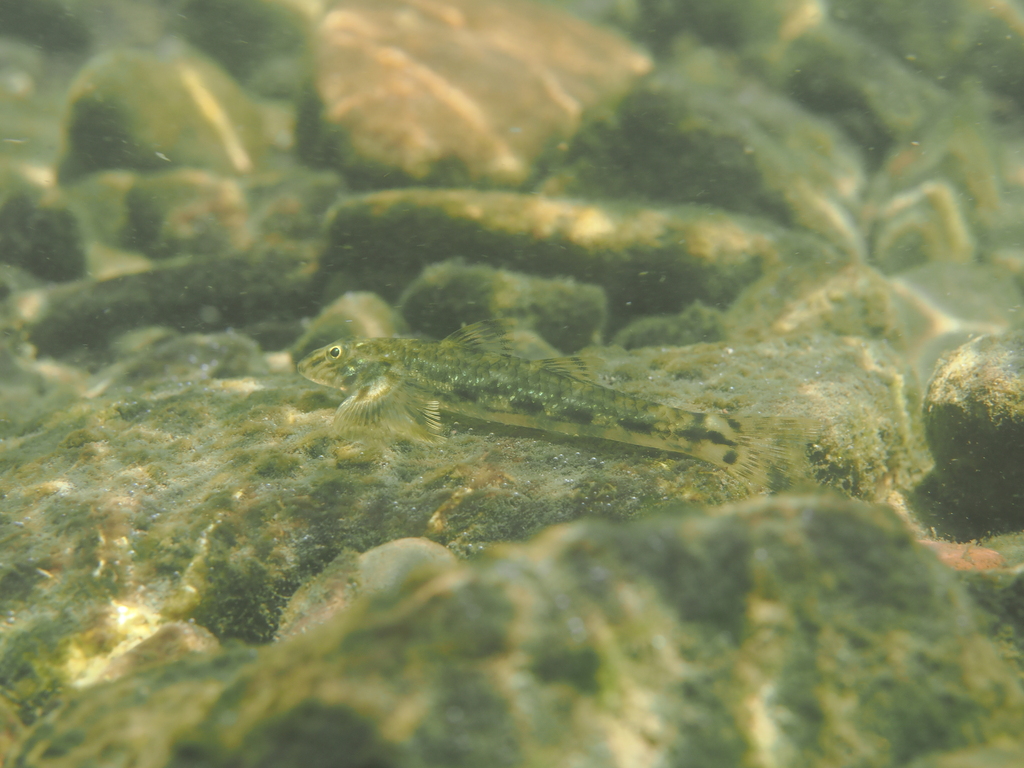
The Loach goby (Rhyacichthys aspro) is a fish that lives in both fresh and salt water of the family Rhyacichthyidae that grows up to 25 cm.
Description
The loach goby is a remarkable goby relative from the Indo-Pacific, ranging from Indonesia and the Philippines to Taiwan, China and some Japanese islands. The species grows to about 25 cm and has a flattened head with the eyes on top, a streamlined body and greatly enlarged pectoral fins with which it can cling to rocks in fast-flowing hill streams. It is amphidromous and tolerates fresh, brackish and salt water; with its inferior mouth it grazes algae and diatoms. Owing to insufficient data the IUCN lists the species as Data Deficient (DD).
Frequently asked questions
How do you recognise the Loach goby?
The Loach goby has an elongate, eel-like body, is mainly brown and shows a plain pattern.
Where does the Loach goby live?
The Loach goby lives in both fresh and salt water and is mostly found around sand or mud bottom.
How big does the Loach goby get?
The Loach goby grows to a maximum of about 25 cm.
Is the Loach goby dangerous to humans?
No, the Loach goby is harmless to humans.
Is the Loach goby edible?
The Loach goby is rarely eaten.
Download Fin's Fish Guide
Identify fish in seconds, log your catches and dives. Join the TestFlight beta.
All data
Identification
Appearance
Habitat & distribution
Behaviour & biology
For anglers
Safety
Status & sources
Download Fin's Fish Guide
Identify fish in seconds, log your catches and dives. Join the TestFlight beta.