Home · Rachycentridae · Cobia
Cobia (Rachycentron canadum) — Rachycentridae

Cobia

Rachycentron canadum
LC · Least Concern

The Cobia (Rachycentron canadum) is a saltwater fish of the family Rachycentridae that grows up to 200 cm.

Length
200 cm
Water
Saltwater
Depth
0.0–1200.0 m
Diet
Carnivore
Behaviour
Solitary
Activity
Diurnal
Body shape
Torpedo-shaped
Substrate
Open water
Danger
Harmless
Edibility
Highly prized

Description

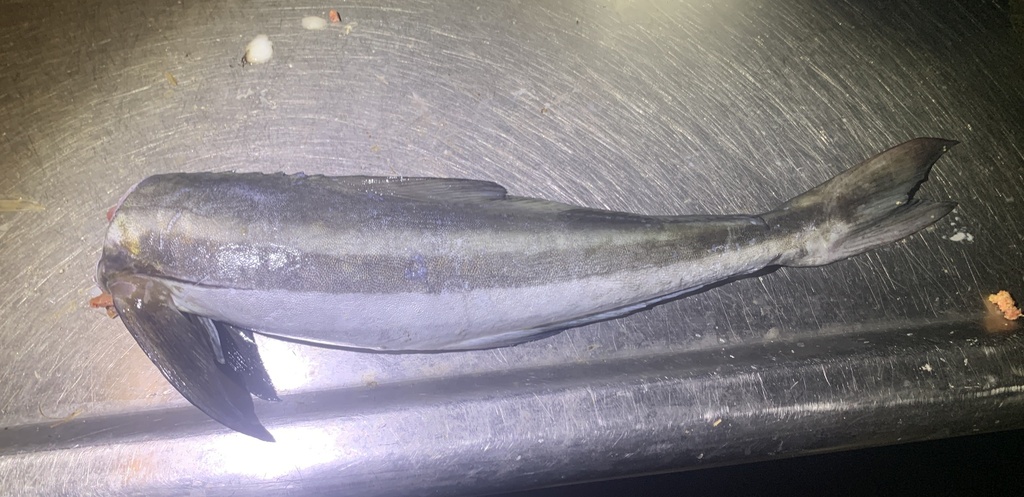
The cobia is a large, streamlined predator of the family Rachycentridae reaching about 2 metres. The brown, elongate body has a flat, broad head and a dark lengthwise stripe with paler edges, making the fish strongly resemble a large remora or even a small shark. The species is widespread in warm seas worldwide and lives pelagically in coastal water, often around wrecks, buoys and floating objects, where it seeks prey. It hunts crabs, shrimps, squid and fish. The cobia is a powerful, sought-after sport and food fish with tasty flesh and is also farmed in aquaculture.

Frequently asked questions

How do you recognise the Cobia?

The Cobia has a torpedo-shaped body, is mainly brown and shows a horizontal stripes pattern.

Where does the Cobia live?

The Cobia lives in the sea (marine waters) and is mostly found around open water.

How big does the Cobia get?

The Cobia grows to a maximum of about 200 cm. On average the species is around 110 cm.

Is the Cobia dangerous to humans?

No, the Cobia is harmless to humans.

Is the Cobia edible?

Yes, the Cobia is a highly prized food fish.

Download Fin's Fish Guide

Identify fish in seconds, log your catches and dives. Join the TestFlight beta.

Get the beta →

All data

Identification

Dutch name
Cobia inferred
English name
Cobia verified
Scientific name
Rachycentron canadum
Family
Rachycentridae
Other names
Black king; Black king fish; Black kingfish verified

Appearance

Size class
Extra large verified
Max length (cm)
200.0 verified
Average length (cm)
110.0 verified
Body shape
Torpedo-shaped verified
Dominant colour
Brown sourced
Pattern
Horizontal stripes sourced
Tail shape
Forked inferred
Mouth position
Terminal inferred
Lips
Thick / fleshy inferred
Barbels
No verified
Dorsal fins
Two separate sourced
Dorsal spines
Yes verified

Habitat & distribution

Water type
Saltwater verified
Substrate
Open water verified
Min depth (m)
0.0 verified
Max depth (m)
1200.0 verified
Origin
Native verified

Behaviour & biology

Diet
Carnivore verified
Social behaviour
Solitary verified
Territorial
No verified
Activity
Diurnal inferred
Reproduction
Separate sexes verified
Sexual dimorphism
No verified
levensduur_max_jaar
15.0 verified

For anglers

Edibility
Highly prized verified
Fishing method
Werpen of slepend vissen met kunstaas of een aasvis bij wrakken, boeien en drijvend wier; een krachtige, gewilde sportvis sourced
Regulations source
FishBase ↗ inferred

Safety

Danger to humans
Harmless verified

Status & sources

Sources
FishBase via GBIF (DwC-A), CC-BY-NC 4.0

Download Fin's Fish Guide

Identify fish in seconds, log your catches and dives. Join the TestFlight beta.

Get the beta →