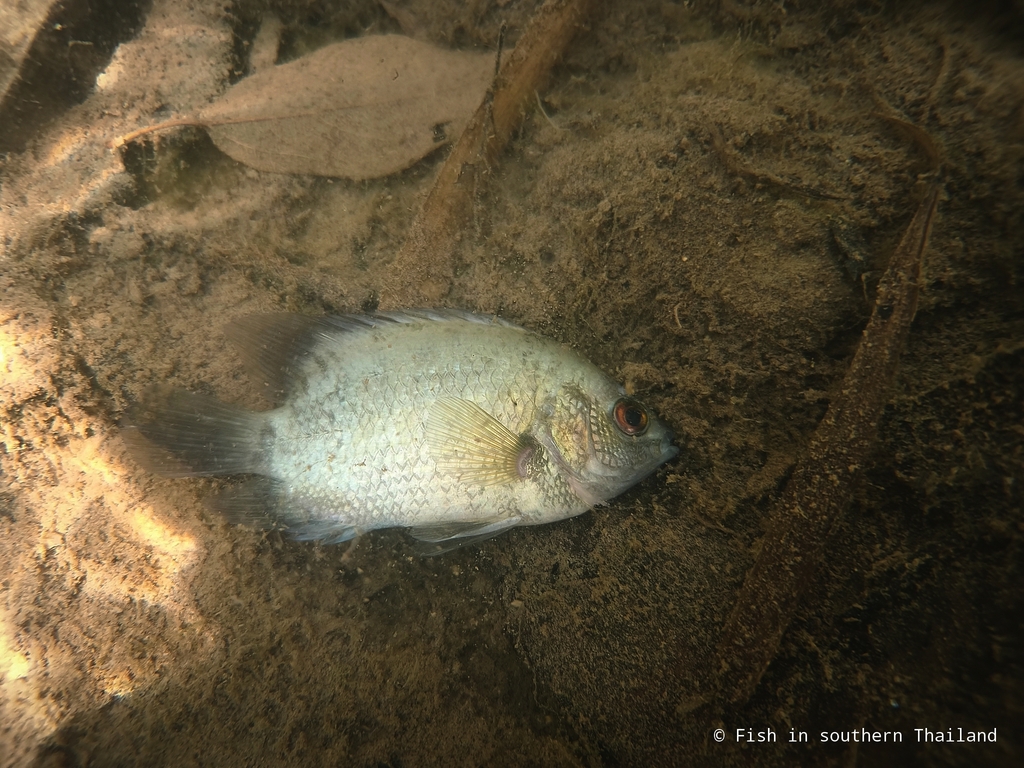
The Catopra (Pristolepis fasciata) is a freshwater fish of the family Pristolepididae that grows up to 31 cm.
Description
The catopra or striped leaffish is a freshwater fish of the family Pristolepididae. The species reaches about 31 cm and has a deep, compressed, brownish body with dark cross-bands and a protrusible mouth. It lives in slow or standing waters among shore vegetation, in rivers, flooded fields, lakes, ponds and swamps. As an omnivore the fish eats filamentous algae, submerged land plants, fruits and seeds, supplemented with aquatic insects and crustaceans. In the Mekong basin it makes lateral migrations to the floodplains in the rainy season and returns at the onset of the dry season.
Frequently asked questions
How do you recognise the Catopra?
The Catopra has a flattened, disc-shaped body, is mainly brown and shows a vertical stripes pattern.
Where does the Catopra live?
The Catopra lives in fresh water and is mostly found around sand or mud bottom.
How big does the Catopra get?
The Catopra grows to a maximum of about 31 cm. On average the species is around 18 cm.
Is the Catopra dangerous to humans?
No, the Catopra is harmless to humans.
Is the Catopra edible?
The Catopra is rarely eaten.
Download Fin's Fish Guide
Identify fish in seconds, log your catches and dives. Join the TestFlight beta.
All data
Identification
Appearance
Habitat & distribution
Behaviour & biology
For anglers
Safety
Status & sources
Download Fin's Fish Guide
Identify fish in seconds, log your catches and dives. Join the TestFlight beta.