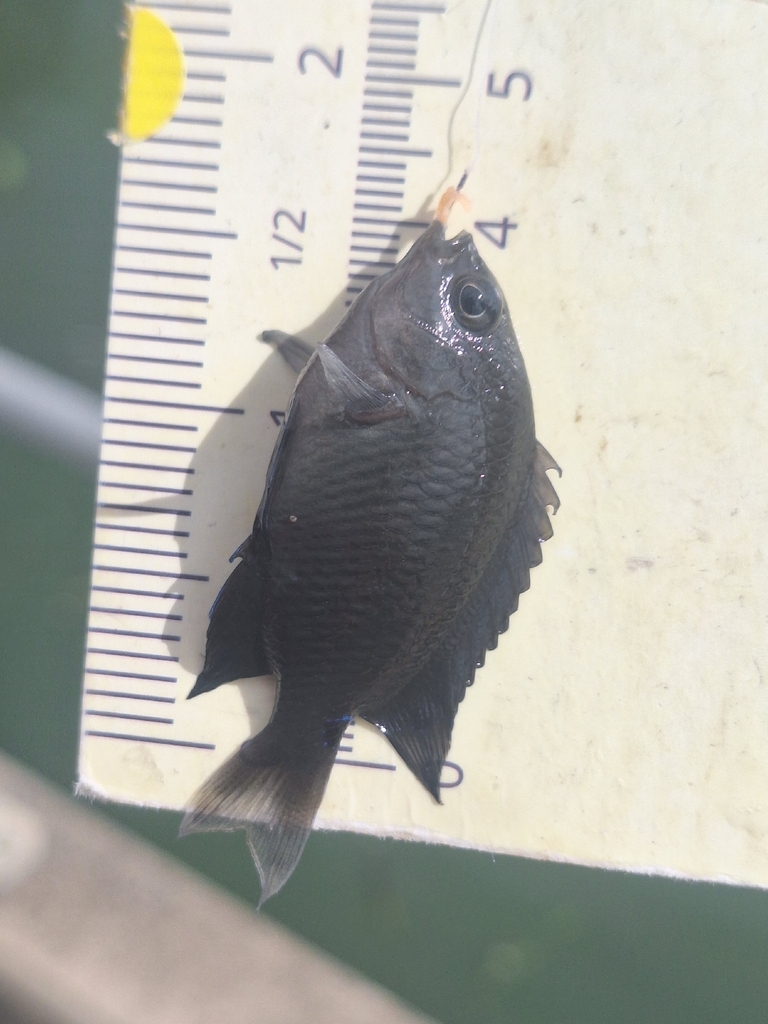
The Threespot damsel (Pomacentrus tripunctatus) is a brackish-water fish of the family Pomacentridae that grows up to 8 cm.
Description
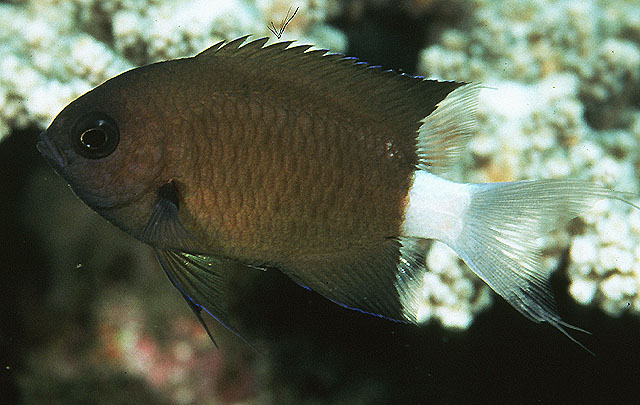
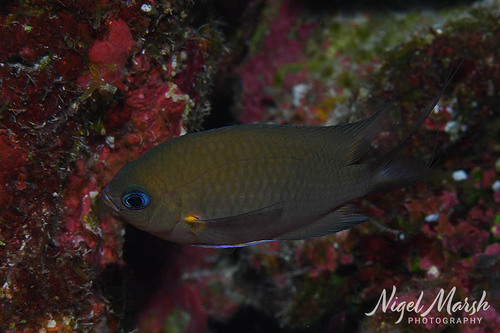
The threespot damsel (Pomacentrus tripunctatus) is a damselfish of the Indo-West Pacific, from Sri Lanka and the Andaman Sea through the Indo-Australian archipelago to the Solomon Islands and Vanuatu. It grows to about 8 centimetres and lives reef-associated in very shallow water (0-3 metres), in turbid bays, silty coastal reefs and harbours with sparse coral and algal growth. The short, disc-shaped body is brownish. This diurnal fish feeds mainly on benthic algae. In spawning a distinct pair forms and the male guards the adhesive eggs on the bottom. The species is harmless to humans.
Frequently asked questions
How do you recognise the Threespot damsel?
The Threespot damsel has a flattened, disc-shaped body, is mainly brown and shows a plain pattern.
Where does the Threespot damsel live?
The Threespot damsel lives in brackish water and is mostly found around stony or rocky ground.
How big does the Threespot damsel get?
The Threespot damsel grows to a maximum of about 8 cm.
Is the Threespot damsel dangerous to humans?
No, the Threespot damsel is harmless to humans.
Is the Threespot damsel edible?
The Threespot damsel is rarely eaten.
Download Fin's Fish Guide
Identify fish in seconds, log your catches and dives. Join the TestFlight beta.
All data
Identification
Appearance
Habitat & distribution
Behaviour & biology
For anglers
Safety
Status & sources
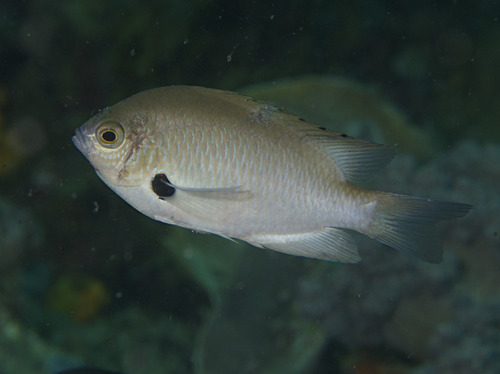
Same genus Pomacentrus
More from the family Pomacentridae
Download Fin's Fish Guide
Identify fish in seconds, log your catches and dives. Join the TestFlight beta.