
The Sixgill sawshark (Pliotrema warreni) is a saltwater fish of the family Pristiophoridae that grows up to 170 cm.
Description
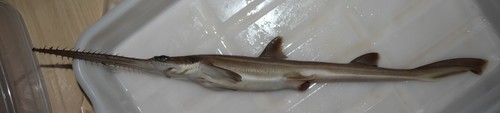
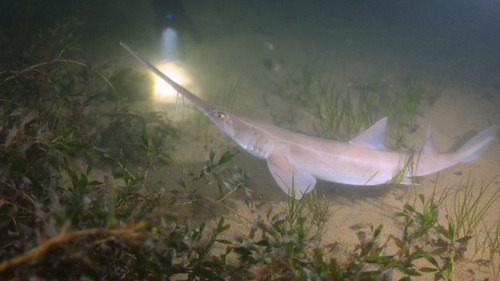
The sixgill sawshark is a sawshark (Pristiophoridae) from coastal waters of the western Indian Ocean, off southern Africa. The species grows to about 1.7 metres and has a slender, yellow-brown body, six pairs of gill slits (unusual) and a long, flat, blade-like snout set with sideways-projecting teeth and a pair of long barbels. With this 'saw' it probes sand and mud bottoms and dislodges prey from the sediment. The saw can cause cuts when handled; remain cautious.
Frequently asked questions
How do you recognise the Sixgill sawshark?
The Sixgill sawshark has an elongate, eel-like body and is mainly brown.
Where does the Sixgill sawshark live?
The Sixgill sawshark lives in the sea (marine waters) and is mostly found around sand or mud bottom.
How big does the Sixgill sawshark get?
The Sixgill sawshark grows to a maximum of about 170 cm.
Is the Sixgill sawshark dangerous to humans?
The Sixgill sawshark can cause injury; handle it with care.
Download Fin's Fish Guide
Identify fish in seconds, log your catches and dives. Join the TestFlight beta.
All data
Identification
Appearance
Habitat & distribution
Behaviour & biology
For anglers
Safety
Status & sources
More from the family Pristiophoridae

Download Fin's Fish Guide
Identify fish in seconds, log your catches and dives. Join the TestFlight beta.