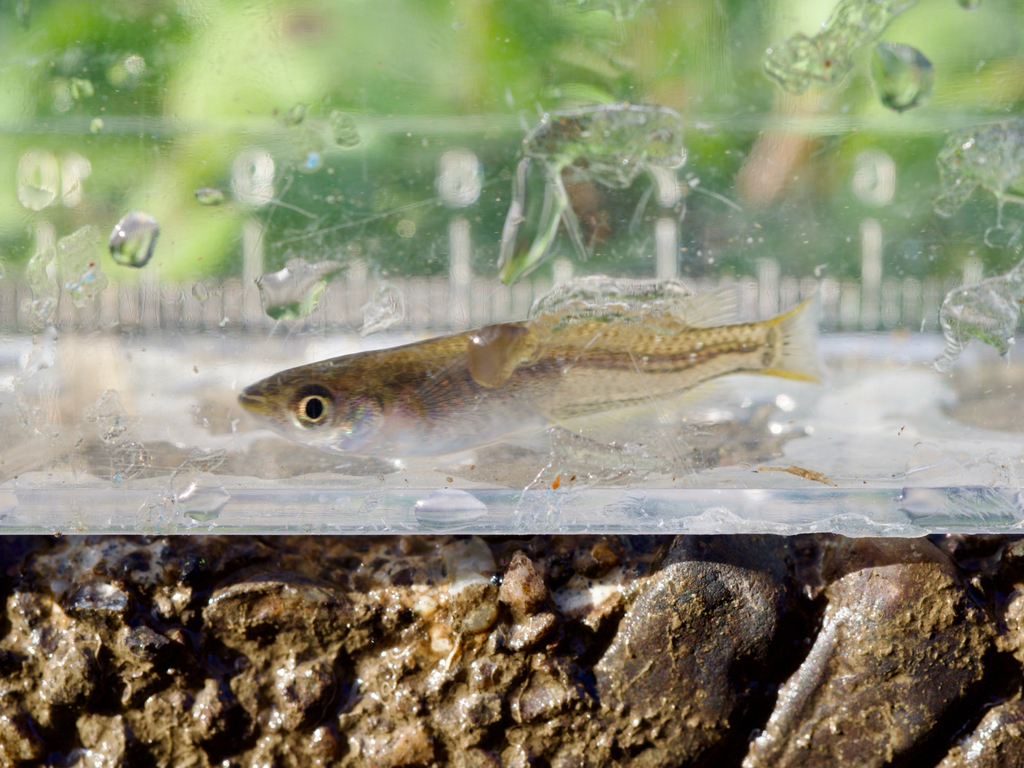
The Japanese rice fish (Oryzias latipes) is a fish that lives in both fresh and salt water of the family Adrianichthyidae that grows up to 4 cm.
Description
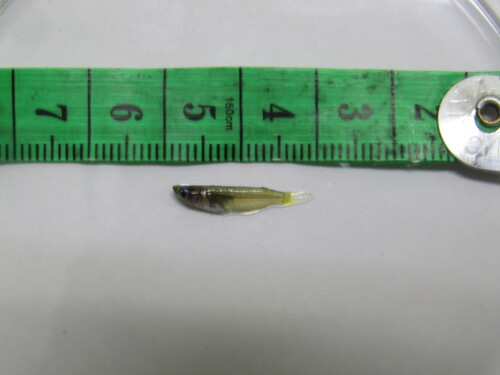
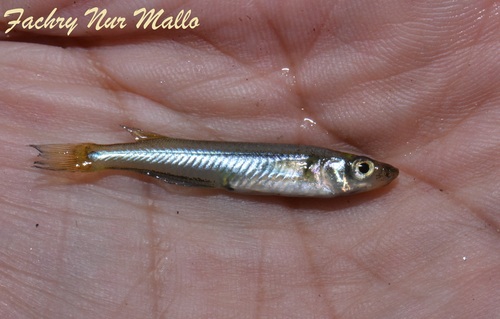
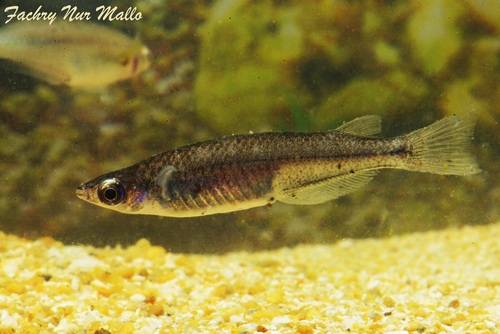
The Japanese rice fish or medaka is a small, hardy surface fish of the family Adrianichthyidae (ricefishes) reaching about 4 cm. The body has a flat back, an upturned mouth and large eyes, suited to life just below the water surface. The species comes from Japan and its surroundings and lives in rice paddies, ditches, ponds and slow-flowing water; it tolerates brackish water and large temperature swings. As an omnivore it eats zooplankton, insect larvae (including mosquitoes) and algae. Notably, the female carries the fertilised egg cluster as a bunch on her belly for a time before the eggs attach to plants. The medaka is a major research animal in genetics and developmental biology worldwide and popular in the aquarium hobby.
Frequently asked questions
How do you recognise the Japanese rice fish?
The Japanese rice fish has an elongate, eel-like body, is mainly yellow-gold and shows a plain pattern.
Where does the Japanese rice fish live?
The Japanese rice fish lives in both fresh and salt water and is mostly found around algae or seagrass beds.
How big does the Japanese rice fish get?
The Japanese rice fish grows to a maximum of about 4 cm.
Is the Japanese rice fish dangerous to humans?
No, the Japanese rice fish is harmless to humans.
Is the Japanese rice fish edible?
The Japanese rice fish is not usually eaten.
Download Fin's Fish Guide
Identify fish in seconds, log your catches and dives. Join the TestFlight beta.
All data
Identification
Appearance
Habitat & distribution
Behaviour & biology
For anglers
Safety
Status & sources
Same genus Oryzias
More from the family Adrianichthyidae
Download Fin's Fish Guide
Identify fish in seconds, log your catches and dives. Join the TestFlight beta.